
Door-to-Door Census Survey Begins Across NCR, Covering Nearly 20 Lakh Homes
More than 13,000 enumerators have started the month-long house listing Census exercise across Noida and Ghaziabad, collecting housing and household data despite extreme summer temperatures.

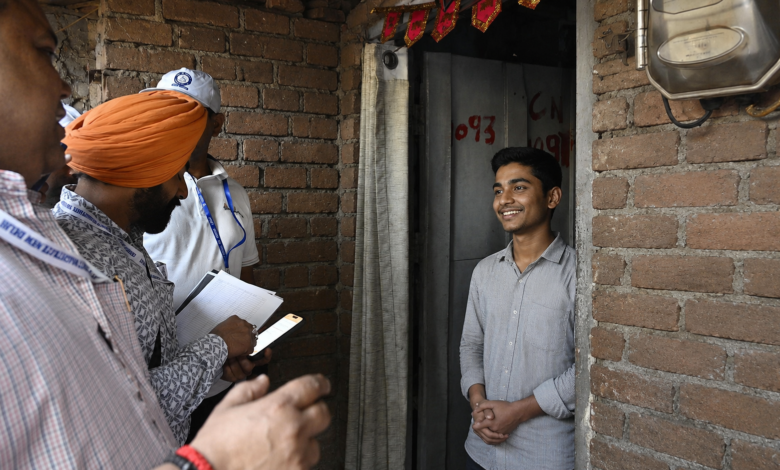
- Nearly 20 lakh homes to be covered across Noida and Ghaziabad
- Survey teams collecting details on housing conditions and amenities
- Officials clarify no documents are required during the Census exercise
Noida/Ghaziabad: The first phase of the Census-2027 exercise officially began across Gautam Budh Nagar and Ghaziabad on Friday, with authorities launching a large-scale door-to-door house listing survey expected to cover nearly 20 lakh households across the NCR region.
Despite temperatures touching 44 degrees Celsius, thousands of enumerators stepped into residential colonies, apartments, and villages to begin collecting data related to housing conditions, household facilities, and occupancy status. Officials said the month-long exercise will continue until June 20 and forms a major part of the initial Census operations.
According to district authorities, Ghaziabad alone has been divided into 7,848 house-listing blocks, where approximately 11.77 lakh houses are expected to be surveyed. In Gautam Budh Nagar, around 8.87 lakh houses fall under 5,914 designated blocks.
Also Read: U.P. RERA Clears 14 Projects Worth ₹3,348 Crore Across 8 Districts
To manage the extensive operation, over 8,000 enumerators have been deployed in Ghaziabad, while more than 5,000 field workers have been assigned across Noida and Greater Noida areas.
Officials explained that enumerators will visit every household in their assigned areas to identify residential structures, prepare layout maps, and digitally record responses from residents. The information collected during this stage will help the government understand housing patterns, living conditions, and the availability of essential amenities in urban and rural regions.
The survey includes nearly 33 questions covering different aspects of household living standards. Residents may be asked about the condition and use of their homes, number of rooms, access to drinking water, toilet facilities, electricity connections, cooking fuel, internet access, and ownership of household assets.
Authorities have clarified that residents are not required to show or submit any documents during the survey process. Officials said the exercise is purely data-driven and intended for socio-economic assessment and planning purposes.
Field workers said the extreme heat has forced them to adjust their daily schedules to ensure smoother operations. Most enumerators are carrying out surveys during relatively cooler hours, mainly in the morning between 8 am and 11 am and later in the evening after 5 pm.
An enumerator deployed in Greater Noida’s Omicron-3 area said afternoon visits are being avoided due to the intense heatwave conditions. According to field staff, conducting surveys during early and late hours is also helping ensure that more residents are available at home.
On the opening day of the exercise, some survey teams reportedly faced hesitation from residents who were initially unsure about the purpose of the Census activity. However, officials said awareness improved after enumerators explained that the house-listing process is part of a nationwide socio-economic survey aimed at assessing housing infrastructure and public amenities.
Also Read: Noida Authority Starts Land Acquisition Across 37 Villages
An enumerator working in Ghaziabad’s Bhatta Road area said many residents became cooperative once they understood the survey’s role in helping authorities evaluate living standards and plan future public services.
District officials have also issued strict instructions to ensure timely completion of the exercise. Authorities warned that action may be taken under provisions of the Census Act, 1948, against personnel found negligent, absent, or delaying assigned work.
The ongoing house-listing drive is considered one of the most important preparatory stages ahead of Census-2027, as the data collected will play a key role in future policy planning, urban development, welfare schemes, and infrastructure decisions across the region.