
NGT Questions GDA Over Colony Built on Ghaziabad Park Land
The NGT has asked the Ghaziabad Development Authority to explain how a colony and other encroachments on land reserved for a park will be removed and how affected families will be rehabilitated.

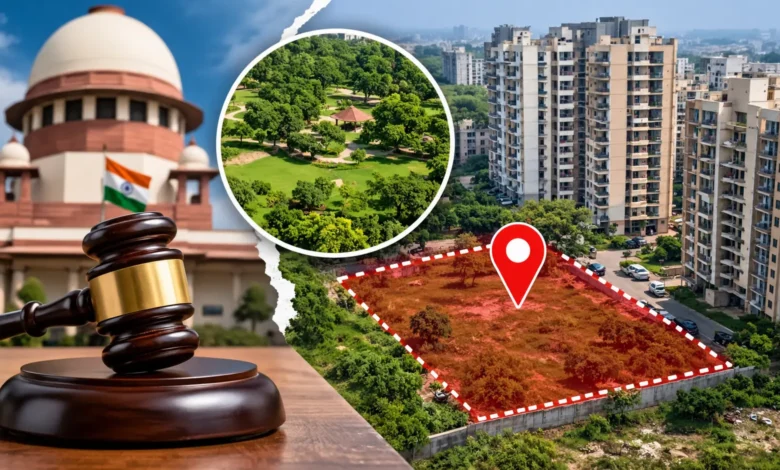
- The disputed site measures around 12,040 square metres and was reserved for a park in a 1962 approved layout.
- A GDA survey identified 172 families occupying about 2,864 square metres of the designated park area.
- The NGT has sought details on removing remaining encroachments and arrangements for affected residents.
Ghaziabad: The National Green Tribunal (NGT) has asked the Ghaziabad Development Authority (GDA) to submit a clear plan for removing unauthorised occupation from land reserved for a park in the Rajendra Nagar industrial area of Ghaziabad. The disputed property, situated off GT Road, was earmarked as green space in a development layout approved in 1962. The matter has gained significance because the site is currently occupied by a residential colony as well as infrastructure connected with nearby industrial units.
The park area covers approximately 12,040 square metres. According to information presented before the tribunal, a survey conducted by the GDA found 172 families living across roughly 2,864 square metres of the designated park land. Roads associated with nine factories were also found to have extended into portions of the land reserved for the park. The dispute therefore involves both the protection of planned green space and the question of rehabilitation for families living on the site.
The NGT, in its September 10 order, sought additional information after reviewing a progress report submitted by the GDA. The tribunal observed that while the authority had provided details concerning the proposed rehabilitation of the affected families, the report did not adequately explain how the encroachments connected with the nine industrial units would be removed. The GDA has consequently been asked to clarify the practical measures it intends to take to restore the land to its approved purpose.
The history of the site dates back to a layout sanctioned in 1962 by the then improvement board, whose functions are now handled by the GDA. Under the approved plan, 12,040 square metres were designated for a park. Over the years, however, parts of the reserved area came to be used for access roads serving industrial units. Babu Jagjivan Ram Colony was later established on a portion of the same land, with 172 dwelling units identified during the GDA’s survey.
The GDA has maintained that the nine factories themselves are not located on the park land. According to the authority’s submission, only roads providing access to those industrial premises had entered the area reserved for the park. The development authority also informed the tribunal that the concerned road had already been demolished as part of its enforcement action.
Action has also been taken against the residential occupation. The GDA issued eviction notices to residents in July 2025 after the NGT proceedings were initiated. However, the petitioner informed the tribunal that the residents subsequently received relief from the Allahabad High Court, which has affected the authority’s ability to proceed with demolition of the colony.
The rehabilitation of the 172 families has consequently emerged as a key issue in the proceedings. Earlier directions from the NGT sought information from the GDA and district administration regarding the arrangements that would be made for residents if the encroachments were removed. The latest proceedings continue to place emphasis on balancing restoration of the designated public land with appropriate arrangements for affected occupants.
The case also highlights the difficulties involved when land reserved for public amenities remains occupied for an extended period. Any effort to restore the park area requires coordination between the development authority, district administration, judicial authorities and affected residents. For Ghaziabad, the proceedings could have wider implications for enforcement of approved layouts and protection of land designated for green spaces.
The GDA is now expected to provide the tribunal with greater clarity on the proposed removal of the remaining encroachments and the rehabilitation measures for affected families. The matter will be considered further by the NGT as the authority’s action plan and compliance details come under review.
Also Read: UP Govt. Reduces Rent Agreement Registration Cost
Also Read: Indirapuram High-Rise Residents Seek Action on Encroachments, Transport and Fire Safety