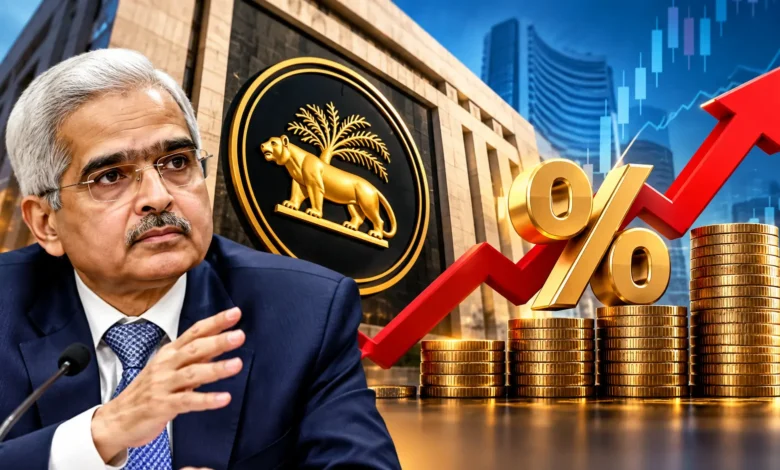
RBI Signals No Rate Cut, December Repo Rate Hike Possible
The Reserve Bank of India is keeping inflation risks in focus, with its next monetary policy decision expected to depend on retail price trends, household expectations and the wider economic outlook.

- The RBI has signalled that an immediate repo rate cut is unlikely.
- Retail inflation is projected to reach 6% in the October–December quarter of FY 2026–27.
- The MPC’s next meeting is scheduled for December 2–4, when policymakers will reassess inflation risks.
The Reserve Bank of India (RBI) has signalled that interest rate cuts are unlikely in the near term, while leaving the possibility of further monetary tightening open if inflationary pressures intensify. The outlook emerged from the minutes of the Monetary Policy Committee (MPC) meeting held from October 5 to 7, as policymakers assessed the risk of rising prices across the Indian economy.
The central bank has projected retail inflation to reach 6% in the October–December quarter of the current financial year, FY 2026–27. This would put inflation at the upper limit of the RBI’s tolerance band. The minutes also highlighted concerns that price pressures could extend beyond food and fuel to a wider range of goods and services, potentially making inflation more persistent.
The MPC meeting focused on the balance between controlling inflation and supporting economic growth. According to the meeting minutes, all six members supported a 0.25-percentage-point increase in the repo rate to 5.50%. However, two members, Nagesh Kumar and Ram Singh, opposed changing the policy stance from neutral to calibrated tightening.
A calibrated tightening approach allows the central bank to consider further interest rate increases if economic conditions require them. The change in stance would therefore signal that policymakers are prepared to raise borrowing costs further rather than consider immediate rate cuts.
RBI Governor Sanjay Malhotra indicated that the shift was intended to communicate that the scope for near-term rate reductions was limited. Future decisions would depend on the inflation outlook, particularly whether rising costs begin spreading more widely through the economy.
Inflation trends have become a key consideration for the RBI. Retail inflation increased from 4.5% in July to 4.8% in August, while core inflation, which excludes food and fuel prices, rose to 4.2%. The central bank has projected average retail inflation at 5.2% for FY 2026–27, with a potential increase to 6% during the October–December quarter.
MPC member Saugata Bhattacharya warned that inflationary pressures could be deepening. He pointed to an increase of around 9% in wholesale input prices, suggesting that businesses may increasingly pass higher production costs on to consumers.
Such a trend could affect household budgets as the prices of everyday goods and services rise. It also raises questions about whether the existing level of interest rates will be sufficient to prevent inflation from becoming more widespread.
While some policymakers favoured a more proactive response to inflation, others cautioned against raising rates too aggressively.
Indranil Bhattacharya argued that the RBI should not wait for inflation to rise further before responding. He noted that price pressures were already visible and that households in both urban and rural areas appeared increasingly concerned about future inflation.
Ram Singh cited the RBI’s September household survey, which showed that households’ inflation expectations for the following three months had risen to 9.9%. He also warned that rising inflation could push the real repo rate below zero. However, he favoured a gradual and limited increase in interest rates, cautioning that prolonged monetary tightening could undermine efforts to support economic growth.
Nagesh Kumar offered a more cautious assessment, arguing that supply-side disruptions were a major factor behind rising prices. In his view, there was insufficient evidence of excessive demand across the economy, making a neutral policy stance more appropriate amid global uncertainty.
RBI Deputy Governor Poonam Gupta also highlighted the role of external supply-side factors in driving inflation. However, she argued that the central bank should act before price pressures become firmly established, as monetary policy changes take time to influence the economy.
A further repo rate increase could help moderate inflation by making borrowing more expensive and potentially reducing demand. However, it could also increase financing costs for households and businesses.
For homebuyers, a higher policy rate may eventually translate into more expensive floating-rate home loans, depending on lenders’ benchmark rates and lending decisions. Existing borrowers with floating-rate loans could also face higher monthly instalments or longer repayment periods. Fixed-rate borrowers would generally be less directly affected during the fixed-rate period.
Businesses may also face higher borrowing costs, potentially influencing investment, construction activity and expansion plans. Bhattacharya cautioned that financial and credit conditions were already tight and that aggressive monetary tightening could weigh on economic growth and foreign investment flows.
Policymakers also considered external risks, including tensions in West Asia, crude oil price volatility and interest rate developments in major economies. These factors could influence India’s inflation outlook, capital flows and broader financial conditions.
The RBI’s next Monetary Policy Committee meeting is scheduled for December 2–4. By then, policymakers are expected to have additional retail inflation data to assess whether price pressures are strengthening or beginning to ease.
The committee will consider the latest inflation figures, household expectations, commodity prices and wider economic conditions before deciding whether to maintain the repo rate at 5.50% or increase it further.
For now, a December rate hike remains a possibility rather than a confirmed decision. The direction of monetary policy will depend on incoming economic data and whether inflation begins spreading more broadly across goods and services.
Also Read: Noida Sports City: Momnathal Villagers Protest Over Land Dispute