How to Check Vastu for Home Entrance
Learn how to check Vastu for your home entrance using a compass, understand the best entrance directions, avoid common mistakes, and follow practical traditional guidelines for apartments and independent homes.

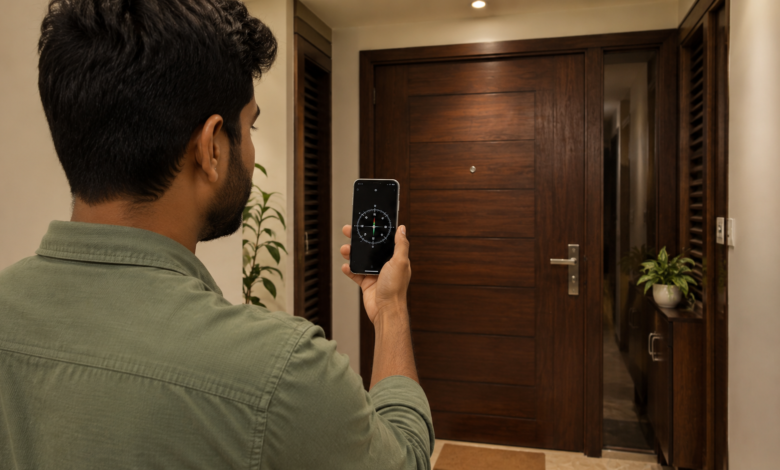
The main entrance is often considered one of the most important parts of a home in traditional Vastu Shastra. It is believed to be the point through which positive energy enters the house, making its direction, placement, cleanliness, and design significant for many homeowners.
Whether you are buying a new property, constructing a house, or evaluating your current home, knowing how to check Vastu for home entrance can help you make informed decisions based on these traditional principles.
The good news is that checking your home’s entrance according to Vastu doesn’t require expert knowledge. With a smartphone compass, a few simple observations, and an understanding of the basic guidelines, you can evaluate your entrance yourself in just a few minutes.
Quick Answer: To check Vastu for your home entrance, stand inside your home at the main door while facing outside. Use a compass or smartphone compass app to determine the exact direction of the entrance. Compare this direction with traditional Vastu guidelines, inspect the entrance for cleanliness, lighting, obstructions, and door placement, and review whether any simple remedies may be appropriate if the entrance falls in a less preferred zone.
Why the Main Entrance Is Considered Important?
The main door is more than just an entry point. In Vastu philosophy, it represents the transition between the outside environment and your living space.
A well-maintained entrance is traditionally associated with:
- A welcoming atmosphere
- Better natural light and ventilation
- Positive first impressions
- Organized living spaces
- A sense of harmony and balance
Regardless of Vastu beliefs, keeping the entrance clean, uncluttered, and well-lit is also considered good home maintenance practice.
Step-by-Step Guide: How to Check Vastu for Your Home Entrance
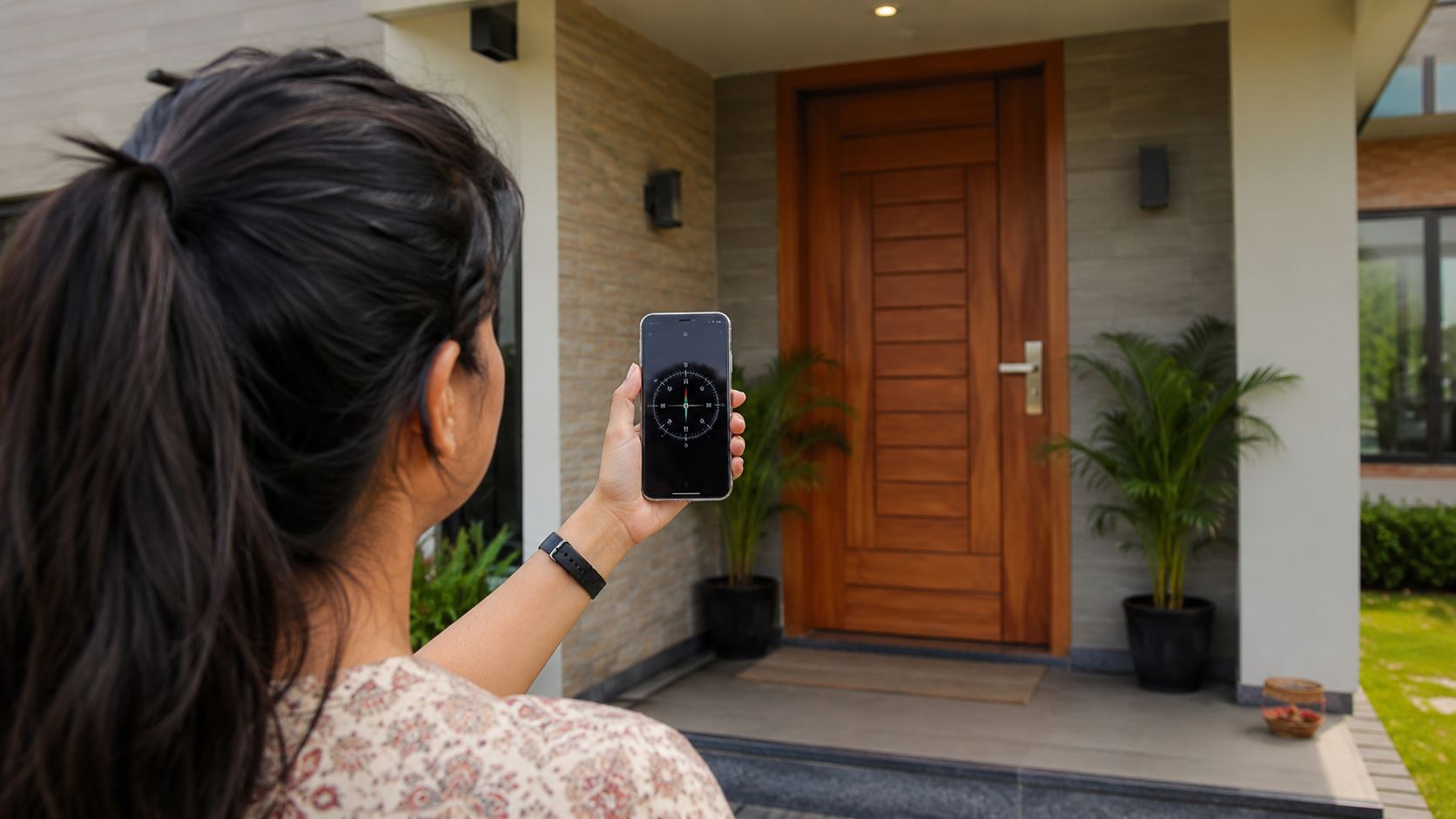
Instead of guessing the direction of your entrance, follow these practical steps.
Step 1: Stand at the Correct Position
Many people make the mistake of checking the direction while standing outside.
The recommended method is:
- Stand inside your home.
- Face towards the outside through your main door.
- This direction is considered your entrance direction according to traditional Vastu practice.
Taking measurements from the wrong position can lead to incorrect conclusions.
Step 2: Use a Compass Correctly
A digital compass on your smartphone is usually sufficient.
To improve accuracy:
- Remove metallic objects from your hands.
- Stay away from large electrical appliances.
- Calibrate the compass if your phone requests it.
- Hold the phone flat.
- Wait until the direction stabilizes before noting the reading.
If possible, take two or three readings at different times and compare them for consistency.
Step 3: Identify the Exact Direction
Once you obtain the compass reading, determine which direction your entrance faces.
| Compass Reading | Entrance Direction |
|---|---|
| 337.5°–22.5° | North |
| 22.5°–67.5° | North-East |
| 67.5°–112.5° | East |
| 112.5°–157.5° | South-East |
| 157.5°–202.5° | South |
| 202.5°–247.5° | South-West |
| 247.5°–292.5° | West |
| 292.5°–337.5° | North-West |
Knowing the exact direction is much more useful than simply estimating it.
Step 4: Compare the Direction with Traditional Vastu Guidelines
Traditional Vastu texts generally describe some entrance directions as more favourable than others.
North Entrance
Traditionally associated with opportunities and prosperity.
Many Vastu practitioners consider a north-facing entrance suitable for homes when combined with proper planning and layout.
North-East Entrance
Often regarded as one of the most preferred entrance zones.
It is traditionally associated with:
- Morning sunlight
- Calm surroundings
- Positive energy
- Spiritual well-being
East Entrance
An east-facing entrance is commonly recommended because it receives the early morning sun.
Many homeowners prefer east-facing homes due to their natural light and ventilation benefits.
West Entrance
A west-facing entrance is not automatically considered negative.
Traditional Vastu suggests that the exact position of the door within the western side plays an important role.
Proper planning is considered more important than direction alone.
South Entrance
A common misconception is that every south-facing entrance is bad.
In reality, traditional Vastu guidance is more nuanced. The exact placement of the entrance, the overall house layout, and other design factors are all considered before reaching any conclusion.
This is why homeowners should avoid making decisions based solely on direction.
Also Read: Top 5 Vastu Plants for Home & Their Benefits
Step 5: Check the Entrance Condition
Direction is only one part of the evaluation.
Traditional Vastu also recommends checking the overall condition of the entrance.
Is the Entrance Clean?
Dust, broken items, overflowing shoe racks, and clutter near the main door are generally discouraged.
Keeping the entrance tidy creates a welcoming environment for residents and visitors alike.
Is There Enough Light?
A dark entrance can make a home feel less inviting.
Natural daylight or adequate lighting near the main entrance improves visibility and enhances the overall appearance of the property.
Is the Door Easy to Open?
The main door should open smoothly without making unusual sounds.
Loose hinges, damaged locks, or broken handles should be repaired promptly as part of routine home maintenance.
Is the Name Plate Clearly Visible?
A clean and readable name plate helps visitors identify the house and contributes to a well-maintained entrance.
Many homeowners also consider it an important element from a traditional Vastu perspective.
Is the Entrance Free from Obstacles?
Check whether any of the following directly block the entrance:
- Large dustbins
- Broken furniture
- Construction debris
- Thick overgrown plants
- Permanent waterlogging
- Damaged pathways
Even from a practical standpoint, removing obstacles improves accessibility and safety.
Also Read: Brahmasthan Explained: Why Your Home’s Center Matters
Apartment Entrance Vastu
Checking Vastu for an apartment entrance is slightly different from checking an independent house.
For flats, focus on the entrance of your own apartment rather than the main gate of the residential society.
When assessing an apartment entrance:
- Measure the direction of your individual flat entrance.
- Ensure the doorway is clean and well-lit.
- Avoid storing unnecessary items outside the apartment door.
- Keep the entrance free from damage or peeling paint.
- Maintain good ventilation whenever possible.
Many apartment owners worry that they cannot improve Vastu because structural changes are difficult. Fortunately, most traditional recommendations focus on maintenance, cleanliness, and organization rather than major renovations.
Common Mistakes People Make While Checking Entrance Vastu
Many homeowners unknowingly evaluate their entrance incorrectly.
Some of the most common mistakes include:
- Guessing the direction without using a compass.
- Standing outside instead of inside while checking.
- Assuming every south-facing home is inauspicious.
- Ignoring the condition of the entrance.
- Believing social media myths without verifying traditional sources.
- Making expensive structural changes without consulting qualified professionals.
- Confusing the building entrance with the apartment entrance.
Avoiding these mistakes can help you assess your home’s entrance more accurately.
Independent House Entrance Vastu
For independent houses, the main entrance is evaluated along with the compound gate, driveway, surrounding landscape, and the overall plot orientation. Traditional Vastu principles consider all these elements together rather than focusing only on the front door.
When checking the entrance of an independent house, pay attention to:
- The exact direction of the main door.
- The location of the compound gate.
- Whether the pathway to the entrance is clear and unobstructed.
- Adequate natural lighting around the entrance.
- Proper drainage to avoid water stagnation.
- Cleanliness and regular maintenance.
A bright, clean, and welcoming entrance generally creates a positive first impression regardless of Vastu beliefs
Simple Home Entrance Improvements
If your entrance does not align with traditional Vastu preferences, avoid making expensive structural changes without professional advice. Instead, consider practical improvements that also enhance your home’s appearance and functionality.
You can:
- Keep the entrance clean every day.
- Improve lighting with energy-efficient fixtures.
- Repair damaged doors, locks, and hinges.
- Paint the entrance if it looks worn.
- Add healthy plants without blocking the doorway.
- Ensure the pathway is safe and obstacle-free.
- Use a durable, high-quality name plate.
These changes can improve both aesthetics and day-to-day usability.
Home Entrance Vastu Checklist
Use this quick checklist to evaluate your entrance.
| Checklist | Yes | No |
|---|---|---|
| Direction checked using a compass | □ | □ |
| Main door opens smoothly | □ | □ |
| Entrance is clean | □ | □ |
| Good natural or artificial lighting | □ | □ |
| No obstacles in front of the entrance | □ | □ |
| Name plate is visible | □ | □ |
| Door is in good condition | □ | □ |
| Walkway is safe and maintained | □ | □ |
The more boxes you can tick, the better maintained your entrance is from both a practical and traditional perspective.
Also Read: Main Gate vs Main Door in Vastu: What’s The Real Difference
Does Home Entrance Vastu Really Matter?
Many people follow Vastu because of family traditions, cultural beliefs, or personal preferences. Others focus primarily on architecture, ventilation, natural light, and functional design.
There is no scientific consensus proving that Vastu principles directly influence health, wealth, or success. However, several recommendations—such as keeping the entrance clean, well-lit, and free from obstacles—are practical home maintenance practices that can improve comfort and appearance.
When making property decisions, it is sensible to consider factors such as:
- Location
- Structural quality
- Legal approvals
- Ventilation
- Sunlight
- Safety
- Budget
Vastu can be one factor among many, rather than the only deciding criterion.
Frequently Asked Questions
How can I check my home entrance direction?
Stand inside your home facing outward through the main door and use a smartphone compass or magnetic compass to determine the exact direction.
Which entrance direction is considered best in Vastu?
Traditional Vastu often considers North, North-East, and East entrances favourable, although the exact position of the door and the overall house layout are also important.
Is every south-facing entrance considered bad?
No. Traditional Vastu does not classify every south-facing entrance as unfavourable. The specific location of the entrance and the property’s complete layout are also taken into account.
Can I check Vastu using Google Maps?
Google Maps can help you estimate your home’s orientation, but a calibrated compass generally provides a more accurate reading for the entrance direction.
Should apartment owners follow entrance Vastu?
Apartment owners usually evaluate the entrance of their individual flat rather than the main gate of the residential complex.
Can entrance Vastu defects be corrected without reconstruction?
Many homeowners focus on practical improvements such as cleanliness, lighting, maintenance, and organization instead of making major structural changes.
How often should I check my home entrance?
Checking the entrance once or twice a year, or after major renovations, is generally sufficient.
Wrap Up
Checking Vastu for your home entrance is simpler than many people assume. By accurately identifying the entrance direction, observing the condition of the doorway, and following practical maintenance practices, you can evaluate your entrance with confidence.
Whether you follow Vastu as a traditional belief or simply want a well-maintained and welcoming home, keeping the entrance clean, bright, safe, and functional benefits every household.
Rather than relying on myths or social media advice, use a systematic approach, understand the traditional guidelines, and make informed decisions that suit your home’s design and your family’s needs.
Also Read: Vastu Tips for Rented House: Easy Vastu Remedies for Every Corner