Indian Architecture at a Crossroads: Tradition, Modernity, and the Question of Identity
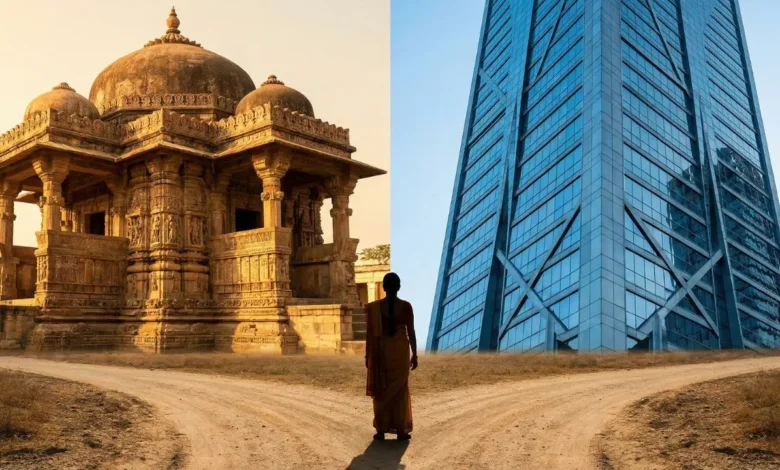
As India reshapes its cities and public spaces, architects and thinkers revisit a long-standing debate: what defines Indian architecture today, and how can it balance heritage, modernity, and ethics?

-
Indian architecture resists a single style, shaped instead by climate, culture, and history
-
Post-independence ideals of modernism are giving way to commercial and political pressures
-
Architects urge a plural, context-driven approach over symbolic nationalism
More than seven decades after Independence, India’s architecture is once again under scrutiny—not for its scale or ambition, but for what it represents. As cities expand and landmark projects redefine skylines, a fundamental question persists: what makes architecture in India truly Indian?
The search for Indianness in architecture is not new. In the years following 1947, newly independent India turned to architecture as a tool for nation-building. Iconic projects from that era symbolised optimism, progress, and a conscious break from colonial rule. Today, however, the ideological compass guiding public architecture appears to be shifting—away from cultural synthesis and towards commercial gain and political messaging.
Critics argue that contemporary practice has normalised the idea that “form follows profit,” often at the cost of cultural depth. In this process, heritage is diluted, and architecture risks becoming a visual instrument for narrow agendas rather than a reflection of collective identity.
Architecture Rooted in Context, Not Motifs
Indian architecture has never been a single aesthetic. From monsoon-responsive structures in the coastal south to stone-built forms in the western deserts, India’s built environment has always been shaped by climate, materials, and local ways of living. Over centuries, diverse cultures—sometimes peacefully, sometimes through force—have left lasting imprints on architectural expression.
This layered history makes it difficult, and perhaps unnecessary, to define Indian architecture through fixed symbols or decorative references. Instead, many architects argue that Indianness lies in responsiveness—to place, people, and purpose.
Throughout the 20th century, this idea gave rise to multiple architectural languages, from Neo-Vernacular and Indo-Deco to Modern Indian Vernacular. These were not rigid styles but evolving responses to India’s social and environmental realities.
Power, Politics, and the Built Environment
Architecture in India has also been deeply intertwined with power. Jawaharlal Nehru’s commissioning of Chandigarh, designed by Le Corbusier, remains one of the strongest examples of architecture as a political statement—signalling a forward-looking nation embracing modernity.
This period opened doors for Indian architects such as Perin J. Mistri, Urmila Eulie Chowdhury, Achyut Kanvinde, Charles Correa, and later B. V. Doshi. While many were trained under Western modernist influences, they consciously adapted design principles to Indian climates, materials, and social needs.
Kanvinde famously warned against both extremes—blind imitation of European modernism and superficial application of traditional motifs. Doshi, meanwhile, developed an architectural language rooted in Indian life, creating spaces that were porous, humane, and climate-sensitive.
A Shift in Recent Decades
The optimism of the post-independence era contrasts sharply with recent developments. The demolition of modernist landmarks such as the Hall of Nations, redevelopment projects like Pragati Maidan and Central Vista, and debates around new public buildings have reignited concerns within the architectural community.
The discussion is no longer only about cost or efficiency, but about architectural intent. Is contemporary public architecture expressing India’s diversity, or is it reinforcing simplified, symbolic narratives? Are nationalist ideas shaping design decisions more than social or environmental responsibility?
Recent debates—such as those surrounding proposed institutional projects—have highlighted discomfort among architects about language, symbolism, and the lingering presence of colonial aesthetics alongside aggressive rebranding efforts.
Rethinking Indianness Today
Scholars and practitioners increasingly argue that Indianness should not be viewed as a binary choice between tradition and modernity. Gautam Bhatia suggests that Indian identity in architecture became self-conscious only in response to external influences. Others, like Anisha Shekhar Mukherji, stress the need to critically re-evaluate indigenous systems without either rejecting or blindly glorifying them.
Architectural researchers Rupali Gupte, Rahul Mehrotra, and Prasad Shetty propose a pluralistic understanding—where Indian architecture holds multiple, overlapping identities that evolve with society. This approach avoids simplistic global-versus-local labels and better reflects India’s complexity.
Contemporary architects, including Aneesha Dharwadker, see hope in a “warm modernism” that reinterprets everyday Indian elements such as courtyards, verandahs, jaalis, and staircases—without resorting to imitation or nostalgia.
Looking Ahead
The real challenge may not be defining Indianness, but safeguarding it from misuse. Architecture, many argue, should resist becoming propaganda. It must question power, not merely serve it.
As India approaches the centenary of its independence, the built environment will play a crucial role in shaping collective memory and future aspirations. Whether architecture can move beyond false binaries—colonial versus nationalist, global versus local—will determine not just how India builds, but what it chooses to stand for.