Ancient Roman Concrete That Repairs Itself Could Transform Modern Construction
Researchers are exploring how ancient Roman concrete could repair its own cracks, potentially inspiring longer-lasting, more sustainable construction materials for modern buildings and infrastructure.

- Ancient Roman concrete used a hot-mixing technique that may help repair cracks through mineral reactions.
- Research at MIT has helped explain how lime-rich fragments contribute to the self-healing process.
- Modern applications could extend the lifespan of structures and potentially reduce construction-related carbon emissions.
A construction technique developed nearly 2,000 years ago could help address one of the modern construction industry’s persistent challenges: cracking concrete. Researchers have been investigating how ancient Roman builders produced exceptionally durable structures, with their findings pointing towards a material that can partially repair its own cracks.
From the Pantheon in Rome to ancient aqueducts, several Roman structures have survived centuries of weathering and environmental exposure. Their durability has attracted considerable scientific interest, particularly as modern concrete infrastructure requires regular inspection, repair and maintenance.
A research team led by Professor Admir Masic at the Massachusetts Institute of Technology (MIT) has explored the role of a technique known as hot mixing. The research, published in 2023, offered new insights into the composition and behaviour of ancient Roman concrete.
How Does Self-Healing Roman Concrete Work?
The key to this ancient construction method lies in the interaction between quicklime, volcanic materials and water.
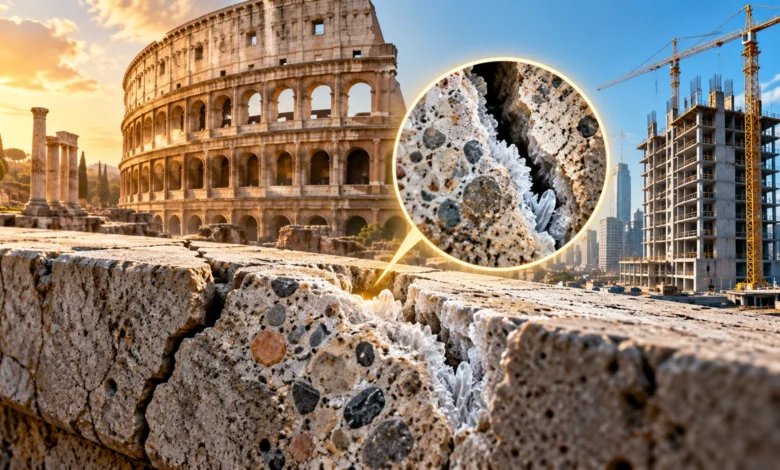
Unlike many modern concrete production methods, ancient Roman builders are believed to have mixed quicklime directly with volcanic ash and other ingredients before adding water. This process generated heat and created small, highly reactive lime-rich inclusions within the mortar.
These inclusions are important because they can participate in chemical reactions when cracks develop in the material.
When water enters a crack, it can dissolve some of the calcium-rich compounds. The dissolved material may then react and precipitate as calcium carbonate, helping fill the damaged area and restrict further water penetration.
Laboratory experiments have demonstrated that this process can seal certain cracks under suitable conditions. However, self-healing does not mean that the material can repair every type of structural damage or restore the original strength of a severely damaged structure.
Pompeii Evidence Supports the Ancient Construction Technique
For years, scientists debated whether Roman builders deliberately used hot mixing or whether the lime fragments found in ancient concrete were simply the result of imperfect material preparation.
In 2025, researchers studying an ancient construction site preserved by the eruption of Mount Vesuvius in 79 AD found evidence supporting the use of this technique.
The site provided a rare opportunity to examine building materials that had been left at different stages of construction. Analysis of the materials indicated that quicklime had been mixed with volcanic ash before water was introduced.
This discovery strengthened the argument that hot mixing was an intentional part of Roman construction practices rather than an accidental feature of the finished mortar.
Modern Construction Industry Explores Ancient Concrete Technology
The potential of self-healing concrete extends beyond historical research. Scientists and businesses are exploring ways to incorporate similar chemical principles into modern construction materials.
DMAT, a company co-founded by Admir Masic and entrepreneur Paolo Sabatini, is developing construction additives inspired by the composition and behaviour of Roman concrete.
Instead of reproducing the ancient recipe exactly, the company aims to adapt the underlying principles for contemporary construction practices. Such technologies could potentially be incorporated into repair mortars and other cement-based materials.
According to claims reported by the company, its technology could extend the service life of certain structures by up to 50% and reduce associated carbon emissions by as much as 60%. These figures are technology-specific claims and should not be interpreted as independently established results for every construction project.
In 2026, a DMAT-designed repair mortar was reportedly used on Switzerland’s N13 motorway in the canton of Graubünden. The application represents an example of how research inspired by ancient materials is moving towards real-world infrastructure projects.
Could Self-Healing Concrete Reduce Construction’s Environmental Impact?
Concrete is among the most widely used construction materials globally. However, conventional cement production is energy-intensive and contributes significantly to carbon dioxide emissions.
Cracking and deterioration can also increase the environmental footprint of infrastructure. Repeated repairs, replacement materials, construction equipment and premature rebuilding all require additional resources.
Self-healing concrete could help address some of these challenges by reducing the need for certain repair operations and extending the useful life of structures.
If buildings, bridges, roads and other infrastructure can remain functional for longer, the construction sector may be able to reduce material consumption and the emissions associated with maintenance and reconstruction.
However, the overall environmental benefits depend on several factors, including the material’s composition, manufacturing process, cost, actual healing performance and the conditions in which it is used.
Challenges Before Widespread Adoption
Despite its promise, self-healing concrete is not yet a universal replacement for conventional construction materials.
Its effectiveness depends on crack width, moisture availability, environmental conditions and the specific chemical composition of the concrete. The technology also needs to meet modern engineering requirements related to strength, safety, durability and cost.
For large infrastructure projects, manufacturers and engineers must establish consistent performance through extensive testing and long-term monitoring.
There is also a difference between sealing a crack and restoring the structural capacity of a damaged component. Self-healing materials may help prevent water ingress and slow deterioration, but significant structural defects still require professional assessment and appropriate repairs.
Ancient Engineering Could Influence the Future of Construction
The renewed interest in Roman concrete demonstrates how historical construction knowledge can contribute to modern engineering innovation.
Instead of relying exclusively on new materials and technologies, researchers are examining ancient methods to understand how earlier civilizations achieved long-lasting construction with the resources available to them.
If modern formulations can reliably reproduce the beneficial properties of Roman hot-mixed mortar, self-healing concrete could become a valuable option for infrastructure maintenance and sustainable building practices.
The technology is still developing, but the central idea is significant: the future of construction may partly depend on understanding how materials were engineered thousands of years ago.
Also Read: How Traditional Indian Houses Stayed Cool Without Air Conditioners: The Science Behind Old Homes
Also Read: Walplast Launches Moisture-Resistant Gypsum Plaster Solutions