Can You Run an Airbnb in a Residential Flat? Ghaziabad Society Dispute Raises Legal Questions
Residents of Windsor Park Society in Ghaziabad have raised concerns over short-term flat rentals, highlighting the rules, permissions and legal rights of homeowners and RWAs.

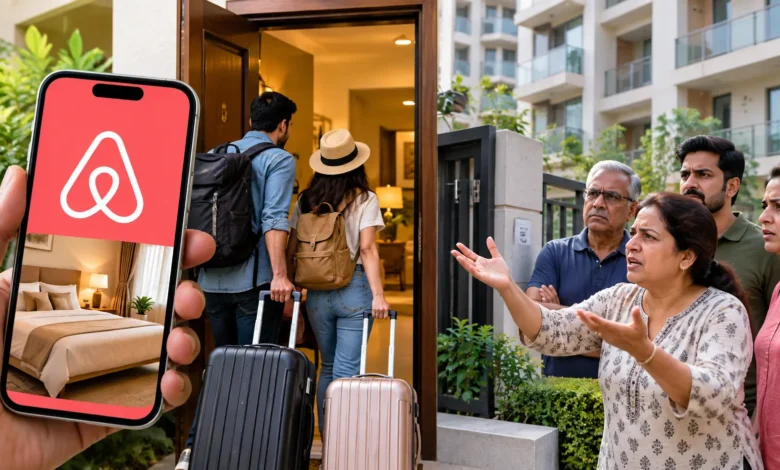
- Windsor Park residents in Ghaziabad have objected to alleged daily rentals in studio apartments.
- Homeowners must check tourism registration, land-use rules and housing society bye-laws before offering short stays.
- RWAs can report violations and take legal action but cannot forcibly evict owners or disconnect essential services.
Ghaziabad: A dispute over alleged short-term flat rentals at Windsor Park Society in Vaibhav Khand, Ghaziabad, has brought the issue of Airbnb-style accommodation in residential apartments into focus. Residents have raised concerns about studio apartments allegedly being rented to visitors for short stays, prompting questions about safety, permissions and the rights of homeowners.
The complaints mainly concern studio apartments in Towers A and B, where residents have alleged frequent movement of unfamiliar guests and possible gaps in police verification and mandatory registration. A joint complaint was reportedly submitted to the district administration, police, Ghaziabad Development Authority (GDA), municipal authorities and the Tourism Department. The matter highlights the growing need to understand how short-term rentals are regulated in residential societies.
The society’s Resident Welfare Association (RWA) has stated that it does not support Airbnb-like activities and has installed a notice board prohibiting such use. The RWA president has also indicated that the association would cooperate with authorities if residents submit substantiated complaints and seek assistance. However, the allegations involving individual flats and possible regulatory violations have not been independently established.
Are Short-Term Rentals Legal in Residential Apartments?
There is no blanket nationwide prohibition on short-term rentals in residential apartments. Their legality depends on several factors, including state tourism policies, local land-use regulations, building approvals, property documents and the registered bye-laws of the housing society.
Under the Uttar Pradesh Bed and Breakfast and Homestay Policy 2025, eligible properties may need to meet specific registration and operational conditions. However, a registered homestay and a flat operated as a commercial short-stay accommodation business may fall under different requirements.
For example, a homeowner living in the property and occasionally hosting visitors may be subject to different conditions from an owner who lives elsewhere and regularly rents out the entire flat to changing guests. The frequency of bookings, nature of services and actual use of the property can all be relevant when determining whether the arrangement complies with applicable rules.
Why Housing Society Rules Matter
Before listing an apartment on Airbnb or another booking platform, homeowners should carefully review their property documents and the rules governing their residential complex.
These may include the sale deed, lease deed, apartment declaration, registered association bye-laws, approved building use and valid resolutions passed by the society. Some residential complexes may have restrictions on commercial activities, paying guests or short-term occupancy.
A Gujarat High Court case, Kamaldeep Singh v. Shivam Satellite Cooperative Housing Society Ltd., has also been referenced in discussions about homestays. The case involved a society resolution restricting homestays and similar accommodation arrangements. The court treated the resolution as binding while it remained in force.
However, the judgment does not establish a universal ban on Airbnb or homestays across India. Its relevance depends on the applicable legal framework and the specific facts of each dispute.
What Legal Risks Can Airbnb Hosts Face?
Operating a short-term rental without the necessary permissions or in violation of applicable property-use restrictions can expose homeowners to legal and regulatory action.
Depending on the circumstances, authorities may issue notices, impose penalties or initiate proceedings. In some cases, a court may restrict the activity through an appropriate order. Hosts may also have to comply with requirements concerning guest records, police verification, fire safety, taxation and other local regulations.
Importantly, tourism registration alone does not guarantee permission to operate a short-term rental in every residential complex. Similarly, an RWA’s approval cannot replace statutory permissions where these are legally required.
Homeowners should therefore verify the rules at every relevant level rather than relying on a single registration, licence or informal approval.
What Can RWAs Do Against Unauthorised Short-Term Rentals?
When residents suspect that a flat is being used in violation of society rules, the RWA can begin by examining its registered bye-laws and relevant legal provisions. If a possible breach is identified, the association can send a written notice to the owner explaining the concern and requesting clarification.
Residents can also approach the appropriate government departments if they suspect violations involving tourism registration, land use, building safety or police verification. Complaints should include relevant supporting documents and factual details so the authorities can assess the matter.
If the alleged violation continues and the governing rules support further action, affected residents or the association may approach a civil court for appropriate relief, including an injunction where justified.
However, RWAs cannot assume the power to forcibly remove homeowners or disconnect essential services such as water and electricity. Blocking guests through force, restricting lawful access or attempting to dispossess an owner can lead to separate legal disputes.
What Evidence Should Residents Collect?
Residents concerned about repeated short-term rentals should focus on collecting verifiable information instead of relying on assumptions or rumours.
Useful records may include screenshots of publicly available rental listings, dates of recurring guest movement, written complaints, relevant incident reports and correspondence with the RWA or authorities.
The association can use this information to compare the suspected activity with its applicable rules and seek an explanation from the property owner. If a possible statutory violation is involved, the relevant authority should determine whether further action is necessary.
Residents should also avoid publicly sharing personal information about owners or guests and refrain from making unverified allegations.
Can an RWA Evict a Flat Owner?
An RWA generally cannot evict a flat owner or take away their ownership rights simply by passing a resolution. Its powers are governed by the applicable laws, registered bye-laws and relevant property documents.
Depending on the circumstances, an association may issue notices, impose legally permitted penalties, enforce valid visitor-management rules, report suspected violations or initiate court proceedings.
In leasehold properties, the original lease conditions and the powers of the relevant development authority may also influence the legal position. The rules can vary between cities, housing projects and types of ownership, making it important to assess each case individually.
Checklist for Homeowners Planning to Offer Short Stays
Before offering an apartment for short-term accommodation, homeowners should:
- Check tourism registration: Confirm whether the applicable state policy requires registration and identify the conditions for eligibility.
- Review property documents: Examine the sanctioned land use, lease conditions, title documents and apartment declaration.
- Read society bye-laws: Verify whether the association has valid restrictions on homestays, paying guests or short-term rentals.
- Meet safety requirements: Check applicable rules for guest records, police verification, fire safety and other mandatory permissions.
- Seek written clarification: Contact the RWA or competent authority if the legal requirements are unclear.
- Maintain compliance records: Keep copies of registrations, permissions, tax documents and other relevant records.
The Ghaziabad dispute highlights the need to balance homeowners’ rental income opportunities with the safety, rights and shared responsibilities of apartment residents. The complaints concerning Windsor Park Society have brought attention to the regulatory questions surrounding short-term accommodation, but the specific allegations will require verification by the relevant authorities.
For homeowners, the next step is to review the rules applicable to their property before accepting short-term bookings. For residents and RWAs, documented complaints, transparent communication and lawful procedures remain central to resolving disputes.
As short-term rental platforms continue to offer new accommodation options, the distinction between a permitted homestay and an unauthorised commercial use of a residential flat is likely to remain an important issue for apartment communities.