
Ajnara Homes Residents Protest as Delivery Staff and Domestic Help Face Entry Restrictions in Greater Noida West
Residents of Ajnara Homes in Greater Noida West have protested alleged entry restrictions imposed by the maintenance agency amid a dispute over unpaid dues and unresolved maintenance issues.

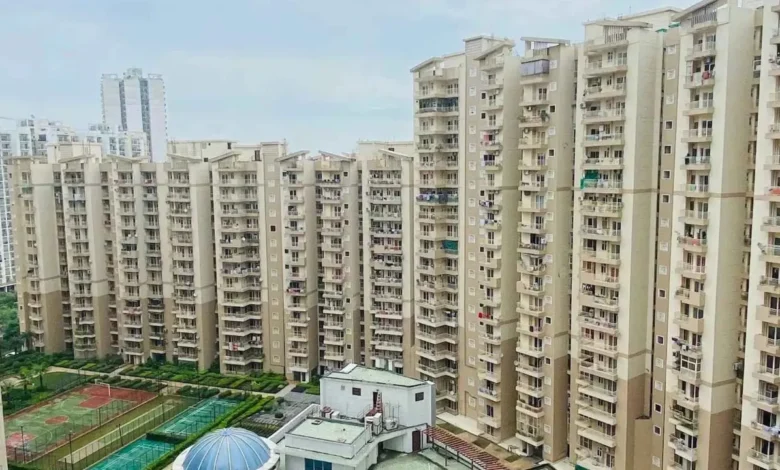
- Residents allege that delivery personnel, domestic workers and other service providers were denied entry to the society.
- Flat owners say they withheld four months of maintenance charges over unresolved issues, including faulty lifts, falling plaster and poor sanitation.
- The Apartment Owners’ Association has approached Bisrakh police, while questions remain over the maintenance agency’s authority to impose restrictions.
Greater Noida: Residents of Ajnara Homes in Greater Noida West staged a protest after the housing society’s maintenance agency allegedly restricted the entry of delivery personnel, domestic workers and other service providers over unpaid maintenance charges.
The dispute came to a head at the society’s main gate, where residents raised concerns about access to essential goods and household services. The conflict has also brought attention to persistent maintenance complaints and the rules governing apartment management in Uttar Pradesh.
The residential complex comprises 15 towers with approximately 2,600 flats and around 10,000 residents, according to the report. Residents said they had withheld maintenance payments for four months because several problems remained unresolved, including malfunctioning lifts, falling plaster, unhygienic basements and inadequate waste management.
They maintained that the outstanding payments were linked to concerns about the quality of maintenance services rather than a refusal to contribute towards the society’s upkeep.
Residents alleged that delivery personnel from platforms such as Amazon, Blinkit and Flipkart were stopped at the entrance, requiring residents to collect their orders from the main gate. The restrictions reportedly affected deliveries of groceries, milk, bread and medicines, along with access to domestic workers.
One resident from Tower C reportedly had to walk approximately 800 metres to collect a milk and bread delivery after the delivery person was denied entry. Residents also alleged that garbage collection, visitor access and other household services had been disrupted at different times.
Beyond the entry restrictions, flat owners raised concerns about the condition of common areas and essential facilities. Their complaints reportedly include sewage treatment plant breakdowns, poor waste disposal, inadequate security and questions about how maintenance charges are calculated.
The Apartment Owners’ Association (AOA) has raised concerns about the maintenance arrangement and the agency’s authority to impose the restrictions. AOA president Chandan Sinha said residents had been seeking the transfer of maintenance responsibilities to the association because the maintenance agency’s agreement had reportedly expired more than four years ago.
Another resident, Dinkar Pandey, alleged that restrictions on visitors and service providers, along with interruptions in garbage collection, had occurred intermittently for nearly a month. The situation eventually led to a confrontation between residents and maintenance staff.
The maintenance agency had reportedly cited financial constraints to explain the condition of the facilities. However, residents said their complaints remained unresolved. According to the report, the agency did not respond to repeated calls and messages seeking its comments on the latest dispute. Its position on the entry restrictions therefore remains unclear.
Following the confrontation, AOA members and other residents met the Station House Officer (SHO) of Bisrakh police station. The officer reportedly assured them that he would take up the matter with the builder’s staff.
The meeting followed concerns that the dispute over maintenance payments had begun affecting residents’ everyday lives. However, the reported assurance does not establish whether any formal action has been initiated or whether the restrictions have been withdrawn.
The dispute has also raised questions about the legal procedure for restricting essential services over unpaid maintenance charges. According to the report, Section 22 of the Uttar Pradesh Apartment Act provides a process under which an apartment owners’ association’s general body may curtail an essential service over unpaid common expenses, subject to specified conditions.
These conditions reportedly include dues remaining unpaid for more than six months, at least seven days’ notice, a general-body resolution, submission of a certified copy to the apartment owner and competent authority, and a further waiting period of one month after the resolution is displayed publicly.
Residents say their payments had been withheld for four months and that the restrictions were imposed by the builder’s maintenance agency rather than through an AOA general-body resolution. The report also notes that the law does not specifically address food deliveries or domestic help, raising questions about how the cited provision applies to these particular restrictions.
The exact legal position may depend on the applicable statutory provisions, the nature of the services restricted and the authority responsible for the decision. The allegations alone do not establish whether the agency’s actions violated the law.
The immediate concern for Ajnara Homes residents is whether normal access for delivery personnel, domestic workers and other service providers will be restored. A resolution will also require the builder, maintenance agency and AOA to address outstanding complaints about lifts, sanitation, sewage management, security and the upkeep of common areas.
The reported meeting with Bisrakh police may provide a channel for discussions between the parties, but the outcome remains uncertain. Residents are also seeking clarity on the transfer of maintenance responsibilities and the basis on which charges are calculated.
The dispute highlights the need for transparent maintenance arrangements and a clear grievance-redressal process in large residential societies. Resolving disagreements over unpaid dues without unnecessarily disrupting residents’ daily needs will be central to reaching a lasting settlement.
Also Read: Prateek Laurel Residents Oppose Proposed STP in Noida’s Sector 120 Green Belt
Also Read: Jaypee Wish Town Residents Protest ₹1.5 per Sq Ft SAM Charges in Noida
One Comment