Supreme Court: Banks Must Verify Construction Before Releasing Funds to Builders
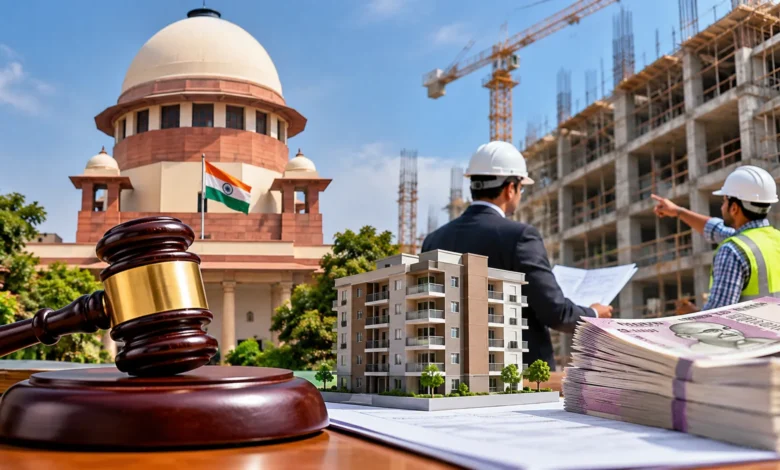
The Supreme Court upheld a bank’s service deficiency for releasing construction-linked loan instalments without documented verification, while limiting the homebuyer’s refund to his own payments and awarding additional compensation.

- Homebuyer entitled to a refund of ₹1.27 crore with 12% simple interest.
- Supreme Court upheld ₹2 lakh compensation against the bank for deficiency in service.
- Builder directed to pay an additional ₹15 lakh for harassment, mental agony and other claims.
The Supreme Court of India has ruled that banks can be held liable for deficiency in service when they release construction-linked housing loan instalments to builders without sufficient evidence that the required construction milestones have been verified.
In the case of Madhu Kudapa v. Lodha Healthy Constructions and Developer Private Limited, decided on October 15, 2026, the Court upheld the finding against Housing Development Finance Corporation Limited (HDFC) while limiting the homebuyer’s refund to the money he had actually paid.
A Bench comprising Justices Pamidighantam Sri Narasimha and Alok Aradhe examined three appeals arising from orders passed by the National Consumer Disputes Redressal Commission (NCDRC). The dispute concerned a flat booked in the Lodha Bellezza residential project in Kukatpally, Hyderabad, in 2009.
Although the buyer had paid a substantial portion of the property price through personal funds and loan-linked payments, possession was never delivered. The ruling addresses two important issues for homebuyers: a lender’s responsibility to monitor construction-linked disbursements and the limits of refunds when a housing loan remains unpaid.
The Court found that the buyer had raised concerns about construction progress before the bank released further instalments. HDFC maintained that its engineers had inspected the site, but it failed to produce inspection reports or other supporting evidence. The Supreme Court therefore upheld the NCDRC’s finding of deficiency in service and retained the ₹2 lakh compensation payable by the bank.
The apartment was booked for approximately ₹2.31 crore, and the buyer initially paid around ₹51.12 lakh from his own funds. HDFC subsequently sanctioned a housing loan of ₹2 crore and released approximately ₹1.69 crore to the builder in 13 instalments between February 2010 and July 2011.
By July 2011, the builder had received approximately 95% of the apartment’s price. However, possession was not delivered within the expected period, prompting the buyer to approach the NCDRC in May 2013. He sought a refund, interest and compensation for the prolonged delay.
The Supreme Court distinguished between the money the buyer had actually paid and the outstanding loan funds disbursed by the bank. It calculated the buyer’s eligible payments at ₹1,27,34,726, comprising his direct payment to the builder and amounts paid towards interest and other loan obligations.
The Court explained that even if a tripartite agreement treats a bank’s payment to a builder as a disbursement to the borrower, this does not automatically make the unpaid loan amount the borrower’s personal money. Awarding the entire amount to the buyer while the loan remained outstanding could result in unjust enrichment.
Consequently, the refund was restricted to ₹1.27 crore, with interest calculated at 12% per annum from the respective dates of payment.
The homebuyer also sought compensation for rental expenses allegedly incurred because he could not occupy the apartment. The Supreme Court rejected this additional rent claim, noting the absence of adequate supporting documents and the risk of awarding overlapping compensation for the same delay.
The Bench also observed that the buyer had opted to seek a refund instead of taking possession of the apartment. In these circumstances, the Court did not consider it appropriate to award additional rent alongside interest and other compensation.
However, the Court recognised the prolonged hardship caused by the builder’s failure to deliver possession. The buyer had paid a substantial portion of the apartment’s price but remained without both the property and the money for years.
Taking these circumstances into account, the Court awarded a lump sum of ₹15 lakh against the builder in full and final satisfaction of the buyer’s claims relating to rent, mental agony, harassment and litigation expenses.
The ruling reinforces the importance of construction monitoring in housing finance arrangements. When a bank sanctions a loan under a construction-linked payment plan, the release of funds should be supported by appropriate verification of the relevant construction stage, particularly where the lender’s own terms require such checks.
For homebuyers, the decision highlights the importance of retaining written communications with lenders and developers. Emails, letters raising concerns about construction progress, payment records and inspection-related documents can become important evidence in a consumer dispute.
The judgment also clarifies that compensation and refunds are not necessarily equivalent to the total amount paid by a lender to a builder. Where the borrower has not repaid the entire loan, the court may distinguish between the borrower’s own payments and funds that remain subject to the lender’s recovery rights.
The Supreme Court modified the NCDRC’s order and directed the Commission to release ₹1,27,34,726 to the buyer, along with 12% simple interest from the dates of the respective payments. It also directed the release of an additional ₹15 lakh as compensation within one month, from the amount deposited by the builder.
The remaining deposited funds are to be kept in an interest-bearing account until the outcome of the bank’s pending appeal. The Supreme Court did not decide the merits of the bank’s recovery claim against the borrower, leaving the parties’ contentions open for consideration by the High Court.
The judgment establishes an important distinction in construction-linked housing finance: lenders may face liability when they fail to substantiate required construction checks, but a homebuyer’s refund remains subject to the actual payments made and the legal rights arising from the outstanding loan.
Case Details
- Case: Madhu Kudapa (formerly K. Madhusudhan Rao) v. Lodha Healthy Constructions and Developer Private Limited & Anr.
- Case numbers: Civil Appeal No. 8994 of 2022 and Civil Appeal Nos. 4622–4623 of 2023
- Court: Supreme Court of India
- Bench: Justices Pamidighantam Sri Narasimha and Alok Aradhe
- Judgment date: October 15, 2026
Also Read: Mahagun Ordered to Refund ₹2 Lakh to Homebuyer in Greater Noida West
Also Read: YEIDA Moves NCLT Over ₹1,000 Crore Suraksha Group Dues