How to Check Cement Quality at Home: 9 Simple Tests Before Using It
Before using a cement bag for your house construction, check its markings, age, texture, lumps, moisture and packaging. These simple checks can help homeowners spot questionable cement before it goes into concrete or mortar.

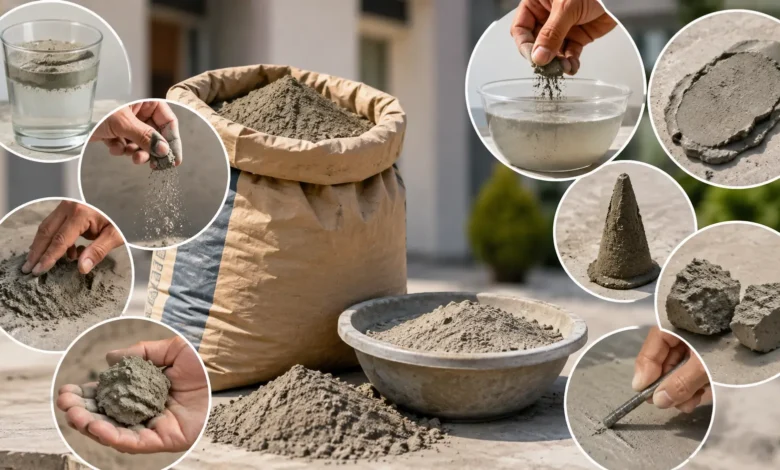
Building a house is a major investment, and cement is one of the materials you should not accept blindly. Before a cement bag is mixed into concrete, mortar or plaster, you can perform several simple checks at home or at the construction site to identify obvious problems.
The most useful checks are not about finding a magic colour or dropping cement into water. Start by checking the bag, BIS/ISI marking, cement type, packing information and signs of moisture damage, and then use physical tests as additional screening. BIS lists cement varieties such as OPC, PPC and Portland Slag Cement under applicable Indian Standards and compulsory certification requirements.
Can You Really Check Cement Quality at Home?
A homeowner can identify several warning signs without laboratory equipment. You can check whether the bag is damaged, whether the cement contains hard lumps, whether it appears unusually coarse or contaminated, and whether the material shows signs of moisture exposure.
However, you cannot confirm the complete quality or compressive strength of cement simply by looking at it or touching it.
Laboratory evaluation of cement can include fineness, soundness, setting time and compressive strength tests. BIS testing information for IS 269:2015, for example, includes these physical performance parameters.
So think of home testing as a screening process:
Home test = identify obvious problems.
Laboratory test = verify technical performance.
9 Ways to Check Cement Quality at Home
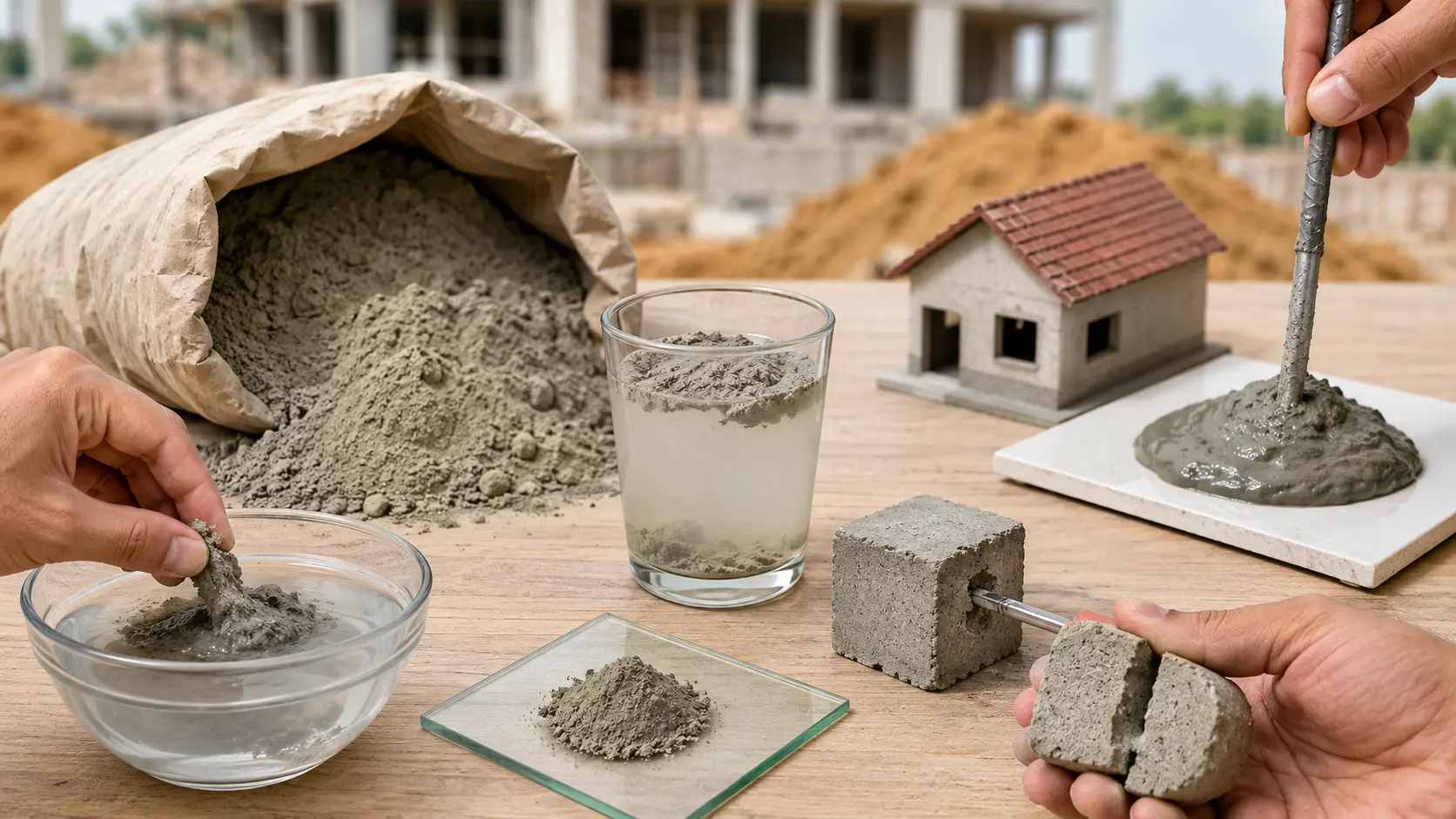
1. Check the Cement Bag and BIS/ISI Mark
Before opening the bag, inspect the packaging.
For cement sold in India, check for the relevant BIS Standard Mark, applicable IS number and licence information. BIS explains that the Standard Mark is used to indicate conformity with the relevant Indian Standard, and the licence number is also required to be indicated with the mark.
Depending on the cement type, the applicable standard can differ. For example:
- OPC: IS 269:2015
- PPC, fly-ash based: IS 1489 (Part 1):2015
- PPC, calcined-clay based: IS 1489 (Part 2):2015
- Portland Slag Cement: IS 455:2015
BIS lists these cement standards under its compulsory certification framework.
What to check:
- Manufacturer/brand name
- Cement type
- Relevant IS number
- BIS/ISI Standard Mark
- License number
- Batch or lot identification
- Packing/manufacturing information
- Net quantity
- Clear and legible printing
Red flag: Missing or suspicious markings, poor-quality printing, altered information or a damaged/resealed bag should make you cautious.
2. Check the Manufacturing or Packing Information
Cement is not a material you should leave sitting around indefinitely.
Check the date or batch information printed on the bag before accepting the material. The exact marking format can vary by cement standard, so don’t assume every code follows the same year-month format.
UltraTech, for example, advises home builders to pay attention to the packing date and notes that cement strength can decline with age.
BIS documentation also requires traceable batch/packing information for cement products.
What should you do?
If the cement is relatively old, has been stored in poor conditions or shows signs of moisture exposure, don’t judge it only by the printed date.
Age + storage condition + physical condition should be considered together.
3. Look Inside the Bag for Hard Lumps
This is one of the most useful simple checks a homeowner can perform.
Open the bag and inspect the cement.
Fresh, properly stored cement should be predominantly a fine powder. Hard lumps are a warning sign because they can indicate that cement has absorbed moisture and partially hydrated.
UltraTech and The Constructor both identify lumps as an important field warning sign.
What is acceptable?
A tiny amount of soft material may behave differently depending on handling and storage, but hard, persistent lumps should not simply be crushed and mixed into structural work.
If a bag contains significant hard lumps:
Set it aside and ask the supplier about replacement.
Don’t assume that grinding the lumps with your hand has restored the original cement quality.
4. Check the Colour
Take a small quantity of cement and look at it under normal daylight.
Cement should generally have a reasonably uniform appearance appropriate to its type.
A significant colour difference within the same bag, obvious foreign material or unusual contamination deserves attention.
However, colour alone cannot tell you whether cement is strong or weak.
This is an important distinction that many online articles miss.
Don’t reject a cement bag simply because it isn’t exactly the same shade as another brand.
Use colour as a visual screening check, not a strength test.
5. Feel the Cement Between Your Fingers
Take a small amount of cement and gently rub it between your fingers.
Good cement should feel fine and relatively smooth rather than obviously gritty or sandy.
UltraTech recommends a sensory check for fineness, while TheConstructor also describes smoothness as a basic field check.
What does a gritty feel mean?
A clearly coarse or gritty texture can be a reason to investigate further.
But don’t make the mistake of saying:
“Smooth cement = guaranteed high-quality cement.”
That’s not technically correct.
Fineness is a laboratory-measured property. BIS testing for cement includes fineness testing under the applicable standards.
The finger test can only help you identify an obvious physical problem.
6. Check for Moisture Damage
Moisture is one of the biggest enemies of stored cement.
Inspect the bag for:
- Damp patches
- Water stains
- Hardened sections
- Caked powder
- Torn packaging
- Bags stored directly on a damp floor
- Cement exposed to rain or high humidity
A bag may look fine from the outside but still contain moisture-damaged cement.
This is why storage history matters just as much as the date printed on the bag.
Cement standards also include requirements concerning packing, storage and marking, reinforcing the importance of protecting cement from unsuitable storage conditions.
7. Try a Small Cement Paste Check
You can make a small paste using cement and clean water as an additional observation.
The objective is not to calculate the cement’s actual strength. Instead, observe whether the paste behaves abnormally.
How to do it
- Take a small quantity of cement.
- Add water gradually.
- Make a stiff, uniform paste.
- Observe its appearance and behaviour while it sets.
A paste that behaves unusually, contains obvious contamination or develops unexpected problems can be a reason to investigate the batch further.
UltraTech lists a consistency check as one of its preliminary on-site checks.
But don’t use a homemade paste test to declare cement “structurally safe.”
Actual setting-time and strength performance require standardized testing.
8. Use the Water or Float Test Carefully
The traditional float test is widely mentioned online.
The basic idea is simple:
- Take a small amount of cement.
- Drop it gently onto water.
- Observe how the particles behave.
Several construction guides describe this as a field test.
But here’s the important part:
Don’t treat the float test as a pass/fail quality certificate.
Different cement compositions can behave differently in water. UltraTech itself notes that light fly-ash particles in PPC can remain floating.
Therefore:
Floating does not automatically mean “good cement.”
And:
Sinking does not automatically mean “bad cement.”
Use this only as a supplementary observation alongside the packaging, age, lumps, texture and storage checks.
This is one area where a lot of online cement-quality articles oversimplify the science.
9. Check How the Cement Was Stored
Even good cement can become unsuitable if it is badly stored.
Before using it, find out:
- Was it kept under a roof?
- Was it protected from rain?
- Was it placed directly on the floor?
- Were bags exposed to damp walls?
- Were older bags used first?
- Were bags torn or damaged during transportation?
If you’re buying several hundred bags for house construction, don’t inspect only one bag.
Check samples from different parts of the delivery.
If one group of bags is noticeably different from another, separate them and investigate the batch information.
Also Read: This Couple Builds Cement-Free Homes in 15 Days Using Industrial Waste for Just ₹7 Lakh
Quick Cement Quality Check: Pass or Warning?
| What you check | Good sign | Warning sign |
|---|---|---|
| Bag | Clean and intact | Torn, wet or resealed |
| BIS/ISI marking | Clear and traceable | Missing/suspicious |
| IS number | Matches cement type | Doesn’t match/unclear |
| Date/batch | Clearly identifiable | Missing or suspicious |
| Powder | Fine and uniform | Obvious contamination |
| Lumps | No significant hard lumps | Hard/caked lumps |
| Texture | Fine, not obviously gritty | Strongly gritty/coarse |
| Moisture | Dry | Damp/caked |
| Storage | Dry and protected | Damp floor/walls/rain exposure |
| Water test | Only supplementary | Don’t use it alone to judge quality |
How to Identify a Potentially Bad Cement Bag
A cement bag deserves further investigation if you notice multiple warning signs, such as:
- Hard lumps throughout the bag
- Damp or wet packaging
- Cement that has clearly caked together
- Missing or suspicious product markings
- Unclear batch/packing information
- Obvious foreign particles
- Damaged or compromised packaging
- Material that has been stored in poor conditions
- Significant inconsistency between bags from the same delivery
One unusual observation does not necessarily prove that the cement is counterfeit or defective.
But several warning signs together should not be ignored.
How to Check if Cement Is Genuine in India
For Indian homeowners, don’t stop at physical testing.
Check the information printed on the bag.
BIS says the Standard Mark indicates conformity with the applicable Indian Standard, and its guidance explains that the licence number accompanies the Standard Mark. BIS also warns about misuse and imitation of the ISI mark.
Check these five things:
1. Brand/manufacturer
Does the manufacturer information look legitimate?
2. Cement type
Is it OPC, PPC, PSC or another specified variety?
3. Applicable IS number
Does the IS number correspond to the cement type?
4. BIS/ISI Standard Mark and licence number
Don’t rely solely on a logo printed on the bag.
5. Invoice and dealer
Keep the purchase invoice and buy from a reliable/authorized dealer whenever possible.
The invoice becomes particularly important if you later need to complain about a defective batch.
OPC vs PPC: Should You Check Them Differently?
Yes, you should be careful about applying one simplistic test to every cement type.
For example, PPC can contain fly ash, and UltraTech specifically notes that lightweight fly-ash particles can affect the result of a float test.
BIS has separate standards for different cement varieties, including OPC and PPC.
Therefore, the correct approach is: First identify the cement type. Then interpret its physical characteristics according to that type.
Don’t compare two different cement varieties solely by colour, floating behaviour or touch.
Can You Confirm Cement Strength at Home?
No, not reliably.
This is probably the most important answer in the entire article.
You can identify obvious physical problems at home, but you cannot determine the cement’s actual compressive strength simply by:
- Looking at its colour
- Touching it
- Checking its temperature
- Dropping it into water
- Making a small paste
- Breaking a homemade sample
Standardized laboratory tests are used to evaluate cement properties such as compressive strength, fineness, setting time and soundness. BIS testing information for IS 269:2015 lists these technical parameters.
So if someone tells you:
“I tested this cement at home and it is definitely 53-grade.”
Be skeptical.
A home inspection cannot replace standardized testing.
When Should You Get Cement Tested in a Laboratory?
Laboratory testing becomes especially sensible when:
- You suspect a defective batch.
- There are many questionable bags.
- The cement was exposed to water.
- You are dealing with a supplier dispute.
- The material is intended for critical structural work and there is a serious quality concern.
- Different bags from the same delivery appear inconsistent.
- You need documented evidence of cement quality.
BIS laboratory information shows that cement can be tested for properties including fineness, setting time, soundness and compressive strength using standardized methods.
For a large house project, the cost of testing a questionable batch can be small compared with the cost of repairing a structural problem later.
What to Do If Your Cement Fails a Quality Check
Don’t simply mix the questionable cement with another good batch and hope the problem disappears.
Instead:
Step 1: Stop using the questionable bags
Keep them separate from accepted material.
Step 2: Photograph the bags
Take clear photos of:
- Brand
- BIS/ISI mark
- IS number
- Batch/lot information
- Packing/manufacturing information
- Damaged areas
- Lumps or moisture damage
Step 3: Keep your invoice
Don’t throw away the purchase receipt.
Step 4: Contact the dealer
Explain exactly what you found and request replacement or clarification.
Step 5: Escalate serious disputes
If the issue concerns a large quantity or structural construction, consider independent laboratory testing rather than relying on visual arguments.
1-Minute Cement Quality Checklist for Homeowners
Before allowing your mason to use a new batch, ask:
- Is the cement bag intact?
- Is the BIS/ISI Standard Mark present?
- Is the license information visible?
- Does the IS number match the cement type?
- Is the packing/manufacturing information clear?
- Are there signs of water exposure?
- Are there hard lumps inside?
- Does the cement look reasonably uniform?
- Does it feel fine rather than obviously gritty?
- Was it stored in a dry, protected place?
- Do different bags from the delivery appear consistent?
- Do I have the purchase invoice?
If several answers raise concerns, don’t ignore them just because the cement is from a well-known brand.
Frequently Asked Questions
Q1. How can I check cement quality at home?
Start with the cement bag, BIS/ISI marking, cement type, packing information, storage condition, lumps, moisture and texture. Simple paste and water tests can be used as supplementary checks, but they cannot prove cement strength.
Q2. What colour is good quality cement?
Cement generally has a uniform grey appearance appropriate to its type. However, colour alone cannot confirm cement quality or strength.
Q3. Should good cement have lumps?
Significant hard lumps are a warning sign because they can indicate moisture exposure and partial hydration. A bag containing substantial hard lumps should be investigated before use.
Q4. Is the cement float test reliable?
Not as a standalone quality test. Cement composition affects how particles behave in water, and PPC may contain lightweight fly-ash particles that can remain floating.
Q5. Can I check whether cement is 43 grade or 53 grade at home?
You can check the grade information printed on the bag, but you cannot reliably verify the cement’s actual strength grade using simple home tests. Laboratory testing is required for technical verification.
Q6. How old should cement be before I avoid using it?
Don’t judge cement age using a single universal rule. Check the manufacturer’s information, applicable standard, storage conditions and physical condition of the cement. Older or poorly stored cement deserves greater scrutiny.
Q7. Is BIS/ISI marking enough to guarantee that my particular bag is perfect?
The Standard Mark indicates conformity with the applicable BIS certification requirements, but homeowners should still inspect the actual bags for damage, moisture, suspicious markings and storage problems. BIS also warns about misuse of the Standard Mark.
Q8. What is the most important cement quality test at home?
For a homeowner, there isn’t one magic test. A combination of bag/marking inspection, packing information, moisture and lump inspection, texture and storage checks is more useful than relying on a single traditional test.
Final Verdict
If you’re building a house, don’t decide whether cement is good based on colour or the water-float test alone.
The smarter approach is to inspect the bag and BIS/ISI information first, verify the cement type and packing details, look for moisture and hard lumps, check the powder’s physical condition, and consider how the material was stored.
And remember: home checks can identify obvious problems, but only standardized laboratory testing can properly assess technical properties such as compressive strength, fineness, setting time and soundness.
That distinction is what separates a genuinely helpful homeowner guide from another generic list of cement tests.