Home Prices Rise 59% as Construction Costs Climb 34% Since 2021
Housing prices across India’s seven major cities have increased far faster than construction costs since 2021, with land prices and fresh West Asia-related cost pressures adding to the burden.

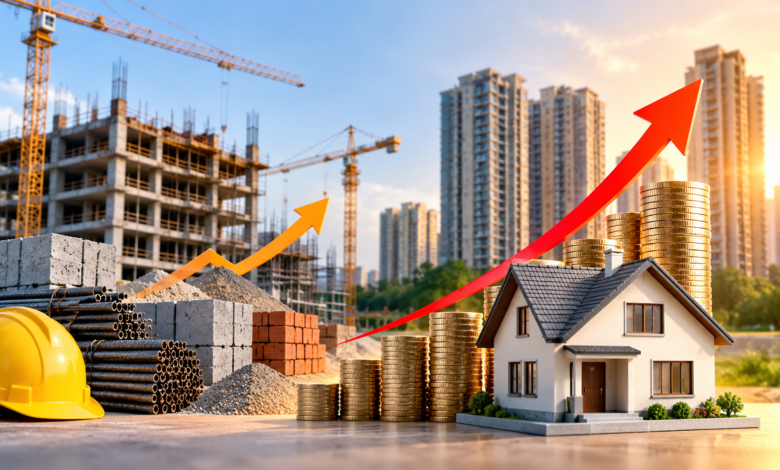
- Residential capital values rose 59% between 2021 and 2025.
- Construction costs increased 34% during the same period.
- West Asia conflict has added an estimated 8–10% pressure to construction costs.
Home prices in India’s seven largest housing markets increased by 59% between 2021 and 2025, significantly outpacing the 34% rise in construction costs over the same period, according to a recent analysis by Anarock Research. The gap highlights how factors beyond construction expenses, particularly rising land values, are playing a growing role in residential price increases.
The report found that the average construction cost for a standard-plus residential project climbed from ₹2,681 per sq ft in 2021 to ₹3,604 per sq ft in 2025, translating into a compound annual growth rate of around 6.9%. Meanwhile, average residential capital values increased from ₹5,826 per sq ft to ₹9,260 per sq ft, recording an annual growth rate of roughly 12%.
Anarock Group Vice Chairman Santhosh Kumar said that rapidly increasing land prices have become an important contributor to higher housing values. He pointed to infrastructure development, location premiums, demand-supply conditions and developer pricing as some of the factors behind the rise in land and residential property values.
According to the research, around 66% of the increase in housing prices can be linked to higher construction expenses, while the remaining 34% reflects factors such as land acquisition costs, developer margins and market dynamics.
Land prices across the top seven cities increased by approximately 50% to 120% between 2021 and the first half of 2026. The NCR saw one of the sharpest increases, with land values rising by an estimated 70% to 130%. Bengaluru also recorded a substantial increase, with land prices moving up by around 60% to 120%.
Higher land acquisition costs can make new projects more difficult to structure financially, particularly in established locations where infrastructure improvements push up land values even before developers launch projects.
Construction companies are now facing another challenge from higher input and logistics expenses linked to the West Asia conflict. Anarock estimates that the conflict has contributed an additional 8% to 10% increase in overall construction costs, with steel and fuel-dependent transportation among the areas seeing the strongest impact.
Steel prices have increased by about 20%, with TMT reinforcement bars reaching nearly ₹72,000 per tonne. Fuel and logistics expenses have also risen by around 15% to 20%. Meanwhile, finishing products such as tiles, glass and hardware have become approximately 8% to 12% more expensive.
Mechanical, electrical and plumbing (MEP) expenses have increased by around 9% to 13%. Between 2023 and 2025, core construction costs rose 13% to approximately ₹2,212 per sq ft, while MEP expenses climbed more than 17% to about ₹788 per sq ft.
The increase in input costs could put pressure on developers, particularly for projects that were launched and sold when construction expenses were lower. In such projects, builders have limited flexibility to increase prices after bookings have already been made.
New launches may provide developers with more room to factor higher land and construction costs into selling prices. However, the ability to pass on these increases may be limited in the mid-income and affordable housing segments, where buyers are already sensitive to higher property prices and borrowing costs.
The combination of expensive land, higher construction inputs and increased logistics costs is likely to remain an important factor in India’s residential market. Developers may increasingly reassess project pricing, land acquisition strategies and construction timelines, while buyers could face higher entry prices in markets where land availability is limited.
For homebuyers, comparing projects based on total acquisition cost rather than just the quoted price per sq ft will become increasingly important as construction, land and associated expenses continue to influence final property prices.