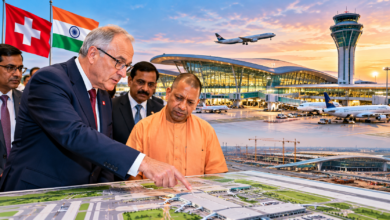
Noida Airport Renamed Narendra Modi International Airport
Uttar Pradesh Cabinet approves renaming Noida International Airport in Jewar after Prime Minister Narendra Modi, as the upcoming aviation hub prepares to expand connectivity and passenger capacity.

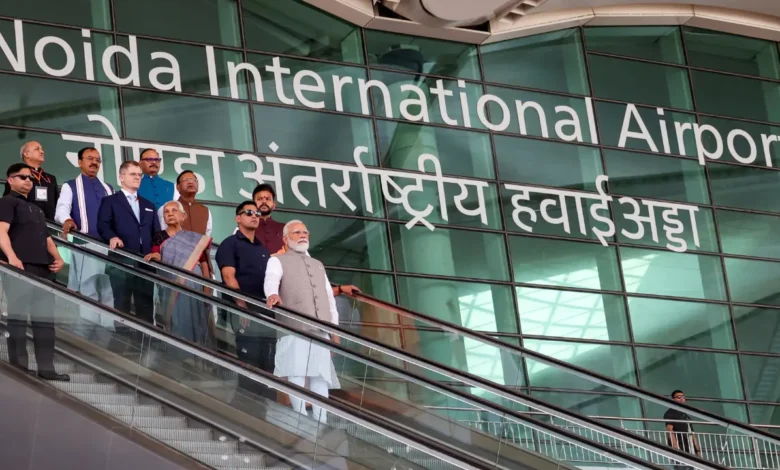
- Uttar Pradesh Cabinet approves the new name, Narendra Modi International Airport, Noida-Jewar.
- The airport’s first phase was developed at a cost of ₹11,282 crore, with an initial annual capacity of 1.2 crore passengers.
- The airport is designed to support future expansion, improved regional connectivity and wider economic growth across Uttar Pradesh.
Noida: Uttar Pradesh Chief Minister Yogi Adityanath announced that Noida International Airport in Jewar has been renamed Narendra Modi International Airport, Noida-Jewar. The state Cabinet has approved the proposal, marking a significant development for the airport, which is expected to become a major aviation hub for Uttar Pradesh and the wider National Capital Region (NCR).
The announcement comes as the airport moves forward with its development as a major infrastructure project near Noida and Greater Noida. The first phase was built at a reported cost of ₹11,282 crore and has an initial annual passenger-handling capacity of 1.2 crore. This capacity is planned to increase substantially as additional phases are developed.
Announcing the Cabinet’s decision, Chief Minister Yogi Adityanath said the state government was grateful to Prime Minister Narendra Modi for the airport. He described the project as a significant contribution to Uttar Pradesh’s infrastructure and said it would play an important role in the state’s aviation development.
The Chief Minister also highlighted the airport’s potential to become Uttar Pradesh’s largest airport and a major aviation centre in India. The Cabinet’s approval formalises the state’s proposal to associate the airport’s name with the Prime Minister.
The airport has been developed by Yamuna International Airport Private Limited, a subsidiary of Switzerland-based Zurich Airport International AG, in association with Noida International Airport Limited, the implementing agency representing the Uttar Pradesh government.
Its first phase includes a 3,900-metre runway designed to accommodate wide-body aircraft, along with modern navigation infrastructure. The runway is equipped with an Instrument Landing System (ILS) at both ends, enabling aircraft to approach from either direction depending on wind and operating conditions.
The airport has also been planned as a multimodal transport hub, connecting air travel with road networks and other transport infrastructure. These facilities are intended to improve passenger movement and support the airport’s role in regional and international connectivity.
The airport’s development is expected to support economic activity across Noida, Greater Noida and the Yamuna Expressway region. Improved air connectivity could strengthen demand for commercial spaces, logistics facilities, hotels, industrial developments and residential properties in surrounding areas.
The project is also strategically important because it adds another major aviation gateway to the National Capital Region. As airport infrastructure and transport links expand, businesses may find it easier to access markets, while the surrounding region could attract additional investment.
However, the scale of these benefits will depend on operational capacity, supporting transport infrastructure, airline connectivity and the pace of development around the airport.
The first phase has an initial annual capacity of 12 million passengers, with plans to scale it up to 70 million passengers annually over the coming years. The expansion is expected to take place in stages as passenger demand grows and additional airport infrastructure becomes available.
Also Read: UP Government Panel Begins Probe Into Jaypee Wish Town Construction Delays
Also Read: Noida Farmers Protest Outside Authority Office Over Pending 10% Developed Plot Allotment