DDA Approves Delhi Master Plan 2047, Sends It to Centre for Final Nod
DDA has approved Delhi Master Plan 2047, setting a long-term framework for housing, transport, infrastructure, redevelopment, environment and sustainable growth as the capital expands toward 2047.

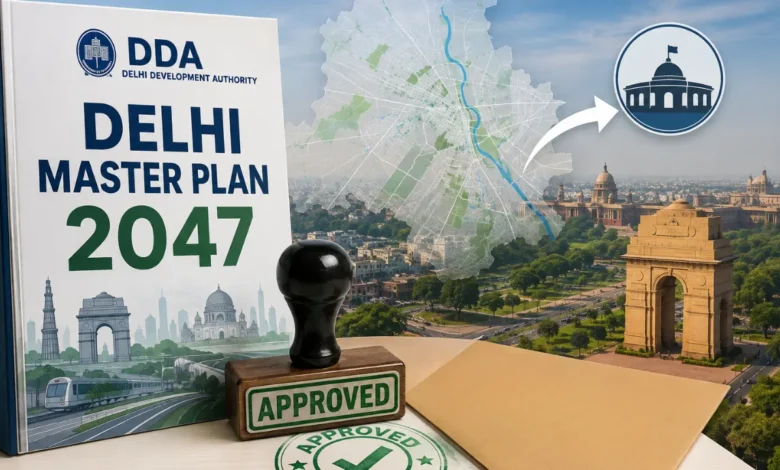
- The plan will now go to the Ministry of Housing and Urban Affairs for final approval and notification.
- A new policy allows reconstruction of ageing two-storey DDA houses on individual plots under specified planning and safety rules.
- Land-use changes were approved for the Rithala-Kundli Metro depot and several other public infrastructure projects.
Delhi: The Delhi Development Authority (DDA) on August 12, 2026, approved the Delhi Master Plan 2047, a long-term blueprint intended to shape the capital’s development over the next two decades. The decision was taken at a DDA meeting chaired by Lieutenant Governor and DDA Chairman Sardar Taranjit Singh Sandhu. The approved plan will now be forwarded to the Ministry of Housing and Urban Affairs for final approval and subsequent notification.
The new master plan is designed to address Delhi’s expected population growth while coordinating housing, transport, economic activity, infrastructure, environmental protection, heritage conservation and urban redevelopment. Its importance extends beyond planning regulations because it will influence how different parts of Delhi accommodate future residential projects, mobility infrastructure, public facilities and economic development.
The DDA said the Master Plan 2047 was developed through a multi-stage review process, including consultations with major administrative and infrastructure agencies. A detailed consultation was held on July 15, 2025, involving organisations and bodies such as the Government of NCT of Delhi, MCD, NDMC, Delhi Jal Board, DMRC, NCRTC and resident welfare associations.
According to the DDA, the plan follows the broader vision of a developed India by 2047. It takes an integrated approach to issues such as housing, mobility, infrastructure, environmental sustainability, heritage, urban regeneration and citizen-focused governance.
The proposal will now move to the Ministry of Housing and Urban Affairs for the next stage. The final implementation will follow the approval and notification process prescribed by the Centre.
Two-storey houses get redevelopment framework
Alongside the master plan, the DDA approved a policy allowing the reconstruction and redevelopment of old DDA-built two-storey dwelling units located on individual plots.
The decision addresses a long-standing issue in older housing schemes, including areas such as Naraina Vihar. Many of these properties were developed under the Delhi Master Plan 1962 and are now more than five decades old. Residents previously faced a lack of a uniform redevelopment framework for built-up two-storey units.
Under the newly approved policy, eligible built-up units will receive redevelopment rights broadly comparable to those available for vacant residential plots. However, reconstruction will have to comply with applicable Master Plan provisions, plot-size requirements, FAR, ground coverage, height limits, structural safety certification and fire-safety regulations.
Applicable conversion charges, scrutiny fees and betterment levy, wherever applicable, will also have to be paid.
Rithala-Kundli Metro depot gets land-use approval
The DDA also approved a change in land use covering 19.63 hectares in Narela Sub-City, allowing land currently classified under recreational and public/semi-public uses to be used for transportation infrastructure.
The change will facilitate the development of the proposed Metro depot for the Rithala-Kundli Corridor. The extension is expected to strengthen connectivity between North West Delhi, Rohini and Narela and provide a direct link towards Kundli in Haryana.
The project could also support development around Narela, including DDA residential projects and the proposed University Hub. Better metro connectivity is expected to improve access for commuters while supporting commercial, residential, hospitality and service-sector activity along the corridor.
The DDA said improved public transport could also help reduce dependence on private vehicles and contribute to lower transport-related emissions.
Building approvals to become easier
The Authority also approved amendments to the Unified Building Bye-Laws (UBBL)-2016 as part of efforts to reduce regulatory requirements and improve the ease of doing business.
One of the key changes is the removal of the earlier requirement to obtain prior No Objection Certificates from certain departments before securing building permits. The reform covers NOCs associated with the Delhi Pollution Control Committee, Chief Inspector of Factories, Delhi Jal Board and Forest Department.
The objective is to reduce procedural hurdles and shorten the time involved in building-plan approvals.
More land-use changes approved across Delhi
The DDA cleared several other land-use proposals during the meeting.
A 7,978-square-metre parcel in Roshanpura has been proposed for the headquarters of the Veterinary Council of India. The land-use category is proposed to change from residential to public and semi-public. A public notice will be issued to invite objections and suggestions.
Another proposal changes the use of a 24,400-square-metre plot near Sarojini Nagar from transportation-related rail circulation to residential use. The DDA will issue a public notice before the change is taken forward.
At Copernicus Lane, three plots covering around 8,494 square metres, including Bungalow Nos. 12, 14 and 16, have been approved for conversion from residential to public/semi-public use. The plots, allotted to Bharatiya Vidya Bhavan, are intended to support its expansion into higher education and research, including work related to traditional Indian knowledge systems.
The Authority also approved the denotification of the Mangolpuri Industrial Area Phase I and Keshopur Industrial Area, with the stated objective of improving maintenance and municipal administration.
Waste-to-energy project in Gazipur
In another environmental-related decision, the DDA approved a land-use change for a proposed Waste-to-Energy (WtE) plant at Pocket-C, Integrated Freight Complex, Gazipur.
The land will be changed from commercial use designated as a freight complex to utility use. The project is intended to support waste management while contributing to cleaner environmental conditions in the capital.
The DDA also approved a separate land-use change covering 752.51 square metres at Pocket-B, IFC Gazipur, from public and semi-public use to recreational use for compensatory green space.
The biggest decision from the meeting is the approval of Delhi Master Plan 2047, but the plan is not yet the final notified planning framework. It will now be submitted to the Ministry of Housing and Urban Affairs for approval and subsequent Gazette notification.
Once notified, MPD-2047 is expected to provide the broader planning direction for Delhi’s growth through 2047, while the other decisions taken by the DDA will move through their respective approval, notification and implementation processes.
For homeowners, developers and investors, the most immediate areas to watch are the redevelopment policy for old DDA housing, changes in land-use classifications, building-approval reforms and infrastructure projects such as the Rithala-Kundli Metro corridor.
Also Read: DDA Opens Applications Under New TOD Policy to Boost Affordable Housing Near Delhi Metro
Also Read: DDA Allows Construction on Vacant Private Plots in Delhi