Sagar Cements Ties Up with Sow & Reap to Install Biochar Units at Telangana Plant
Sagar Cements has signed a long-term agreement with climate-tech firm Sow & Reap to deploy biochar and gasification units, aiming to cut emissions and support its net-zero roadmap.

-
Biochar project to reduce fossil fuel use in cement manufacturing
-
Agricultural waste to be sourced locally within 20 km radius
-
Phase-1 targets 6,000 tonnes annual carbon emission reduction
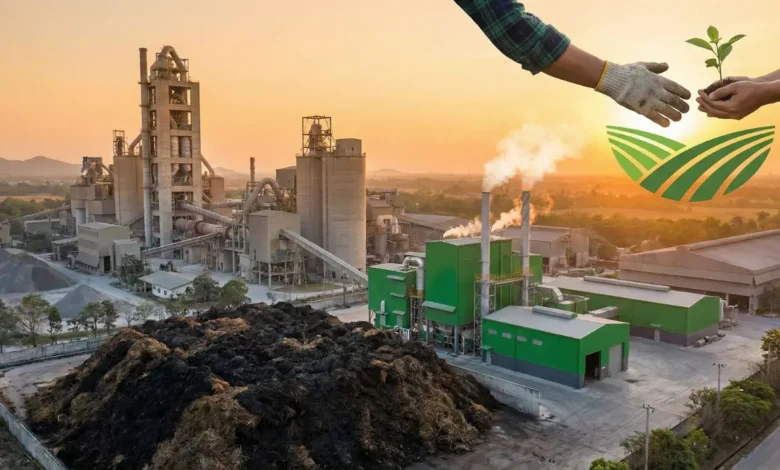
In a move to accelerate decarbonisation in cement manufacturing, Sagar Cements Limited has entered into a 10-year offtake agreement with climate-tech startup Sow & Reap Chara Pvt Ltd to deploy integrated biochar and gasification units at its Mattampally cement plant in Telangana.
The initiative, branded ‘CHARA’, is designed to address emissions from the energy-intensive calcination process—one of the largest contributors to carbon output in cement production. Under the project, agricultural residues, mainly cotton crop waste collected from nearby villages within a 20-kilometre radius, will be converted into syngas and biochar.
Sagar Cements will use the syngas as an alternative fuel, reducing dependence on fossil fuels, while the biochar will be supplied back to farmers for soil application. This process enables long-term carbon sequestration and helps curb air pollution caused by open-field burning of crop residue.
According to project estimates, the initial deployment is expected to cut nearly 6,000 tonnes of carbon emissions annually. If expanded to four units at a single location, emission reductions could rise to 25,000 tonnes per year. Each unit requires an investment of approximately Rs 14 crore and can process about 15,000 tonnes of biomass annually, producing nearly 3,750 tonnes of biochar and mitigating close to 8,000 tonnes of CO₂.
Sow & Reap stated that Phase-1 will see four units become operational by March 2026, with plans to scale the project to 20 units in phases. Once fully deployed, the installations are expected to generate around 1,60,000 carbon credits annually, with a target of issuing nearly 1 million credits over the next five years.
Industry experts view the partnership as a significant step toward cleaner cement production, combining renewable energy substitution, waste management, and carbon credit generation. The project aligns with Sagar Cements’ broader goal of achieving net-zero emissions by 2030, while also delivering environmental and economic benefits to local farming communities.