
Union Budget 2026: Real Estate Impact Explained
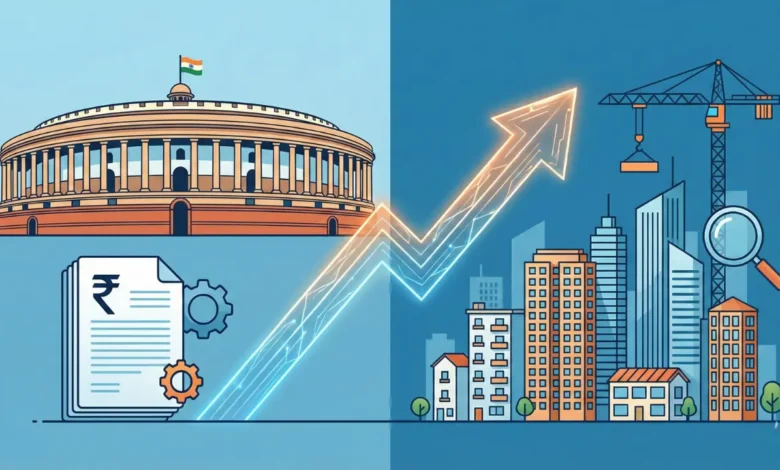
Union Budget 2026 signals a strategic shift in India’s property sector, focusing on infrastructure, institutional capital, and Tier-2 cities while scaling back buyer tax incentives, redefining how real estate growth will unfold.
-
Infrastructure Risk Guarantee Fund aims to ease funding for large projects
-
Tier-2 cities get a ₹5,000 crore push, opening new investment corridors
-
Middle-class homebuyers see no major tax relief on housing loans
India’s real estate sector received a quiet but decisive reset in Union Budget 2026. Presented by Nirmala Sitharaman, the budget moves away from short-term housing incentives and instead lays the groundwork for long-term capital flow, infrastructure creation, and institutional participation.
In simple terms, the government is no longer trying to spark demand through tax breaks. Instead, it is building systems that allow private capital to move faster, safer, and at scale.
A Shift from Subsidies to Structure
Rather than focusing on buyer-centric giveaways, Budget 2026 prioritises transparency, financing efficiency, and new development corridors. The broader goal is to make Indian real estate more investable and less speculative—closer to how mature global property markets function.
Three themes stand out:
-
easier project financing,
-
decentralised urban growth, and
-
stronger financial frameworks for commercial assets.
Together, they signal a transition from subsidy-led housing cycles to infrastructure-backed expansion.
What It Means for Developers
For builders and township developers, the most impactful announcement is the Infrastructure Risk Guarantee Fund. By offering risk cover during the construction phase, the government has reduced lenders’ exposure, potentially lowering borrowing costs for credible developers. This could help revive stalled projects and accelerate new large-format developments that require heavy upfront capital.
Another major opening comes from CPSE land monetisation through REITs. Large parcels of prime urban land held by public sector entities are expected to enter the market, creating opportunities for joint ventures, redevelopment, and mixed-use projects in high-demand locations—without the usual hurdles of fresh land acquisition.
However, the sector’s long-pending demand for formal “industry status” was left untouched. As a result, developers will continue to borrow at commercial rates. The takeaway is clear: access to smarter capital now matters more than regulatory labels. Players who can optimise balance sheets, use REIT structures, and align with infrastructure-led growth are likely to pull ahead.
Homebuyers: Affordable Gets Support, Middle Class Waits
For end users, especially salaried buyers, the budget’s impact is felt more through what did not change.
The home loan interest deduction under Section 24(b) remains capped at ₹2 lakh—a limit unchanged since 2014, even as property prices in major cities have climbed sharply. At the same time, the expanded new tax regime has made traditional housing deductions less relevant for many taxpayers.
While PMAY-U 2.0 receives higher allocations, benefiting EWS and LIG segments, price caps mean its effect in metro markets will likely remain limited. Buyers looking at homes above ₹75 lakh received no direct relief.
The result: affordable housing gains momentum, but the middle class continues to face pressure from rising prices and stagnant tax benefits. The era of buying homes primarily for tax savings is steadily fading.
Also Read: Amrapali Sapphire-II Fined ₹73.40 Lakh for Environmental Violations in Noida
Investors: Follow Where the Money Flows
Budget 2026 sends some of its strongest signals to investors.
A dedicated ₹5,000 crore allocation for Tier-2 city development points to a deliberate push beyond saturated Tier-1 markets. Cities like Indore, Coimbatore, and Nagpur are being positioned as the next growth engines, offering relatively lower entry prices and higher long-term potential.
Equally important is the rollout of Digital Public Infrastructure (DPI) for land records. Cleaner titles and standardised data could significantly reduce legal risk—one of the biggest barriers for institutional capital. As transparency improves, participation from domestic funds, REITs, and global investors is expected to rise.
Adding to this, REITs will be treated more clearly as equity instruments from July 2026, opening the door to potential index inclusion. This could attract passive fund flows and improve liquidity in commercial real estate, strengthening India’s position in global property markets.
Also Read: YEIDA Ends OTS Window, Recovery to Begin for 7,200 Defaulters from March
The Bigger Picture
Union Budget 2026 marks a philosophical shift for Indian real estate.
This is not a demand-stimulation budget. It is a systems-building budget.
Infrastructure, digital land records, and financial instruments now take precedence over direct buyer incentives. Tier-2 cities are being groomed as tomorrow’s growth hubs. Transparency is becoming as critical as physical roads. And market-led development is replacing tax-driven home purchases.
The larger message is unmistakable: India is moving toward a more institutional, capital-efficient real estate ecosystem. How quickly developers, buyers, and investors adapt to this new framework will determine who benefits most from Budget 2026.
About H4ENEWS
At H4ENEWS, we are more than just a news portal – we are your ultimate destination for everything related to home decor, real estate, architecture, Kitchen, Bathroom, Vastu, Celebrity, construction and more. Our mission is simple: to keep homeowners, buyers, sellers, real estate enthusiasts, and industry professionals informed with accurate, reliable, and timely news.