
Singapore’s Construction Boom Accelerates as Mega Projects, Rising Costs and New Tech Reshape the Sector
From Changi Airport’s new terminal to major healthcare and mixed-use developments, Singapore’s construction sector is powering ahead—supported by technology, pressured by rising costs, and driven by billions in fresh project awards.
-
Construction demand projected to hit S$53 billion in 2026, a sharp upward revision
-
Building costs expected to rise up to 5% this year amid supply and labor pressures
-
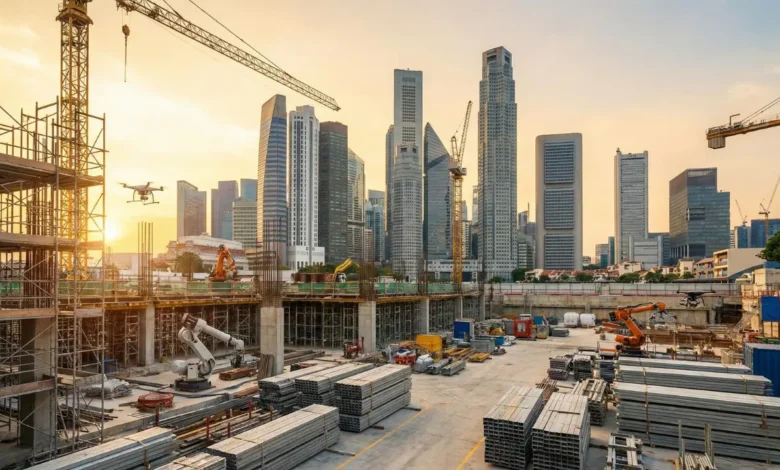
Drones, robots, and digital tools are transforming productivity across job sites
Singapore: The city-state’s construction industry is riding a powerful post-pandemic upswing, fueled by landmark developments, strong public-sector investment, and rapid adoption of automation. Major projects breaking ground in 2025—including a new terminal at Changi Airport and an $8 billion integrated resort by Las Vegas Sands—are reshaping Singapore’s skyline, while hospitals, housing, and transport upgrades continue to roll out nationwide.
Another flagship project, the Tengah General & Community Hospital, is expected to add around 4,000 patient beds by 2030, underscoring the government’s focus on long-term healthcare capacity alongside commercial growth.
Momentum is building fast. In January, Building and Construction Authority revised its outlook, projecting construction demand of up to S$53 billion this year—about a 15% increase from earlier estimates. Industry leaders say activity has surged since Covid-19 disruptions eased, with contractors now managing fuller order books than at any time in recent years.
But the boom comes with challenges.
Costs climb as labor tightens
Despite the healthy pipeline, Singapore remains one of the world’s most expensive places to build. Consultancy Turner & Townsend estimates construction costs could rise by as much as 5% this year, driven by supply-chain delays for cement and ready-mixed concrete, longer lead times for plumbing and electrical systems, and higher semiconductor prices.
At the same time, firms are grappling with a tight market for PMET roles—professionals, managers, executives, and technicians—alongside shortages of specialist subcontractors. To ease capability gaps, the BCA plans to roll out additional training programs for project managers later this year.
Analysts at CGS International Securities expect contract awards to remain strong into 2026, followed by several years of elevated activity. Many companies are responding by “double hatting”—cross-training staff so smaller teams can handle multiple responsibilities, helping projects stay on track.
Robots, drones and a “digital renaissance”
Technology is quickly becoming a cornerstone of productivity.
Developer Soilbuild says it is shifting toward high-specification industrial projects while increasing the use of prefabrication and enterprise risk management systems to improve cost efficiency. Meanwhile, building maintenance firm ISOTeam already deploys drones and AI to inspect façades—and is developing drones capable of washing and painting exteriors, reducing the need for scaffolding and high-risk manual work.
Construction sites are also adopting computer vision tools from OpenSpace and scheduling and defect-tracking software from PlanRadar, both of which report rising demand from Singapore-based contractors.
On the automation front, Legend Robot is supplying machines that spray paint, grind floors, and lay tiles. According to the company, a single painting robot can cover up to 1,500 square meters a day—more than seven times what an average worker typically achieves. While such robots cost between roughly $70,000 and $120,000, demand is growing across Asia, the Middle East, and Europe.
To accelerate adoption, the BCA will begin offering new grants from April to help smaller firms invest in robotics and automation—technologies that can deliver up to 50% manpower savings. Authorities are also encouraging wider use of digital systems for contract management and regulatory approvals.
Still, experts warn that buying software alone isn’t enough. Companies must rethink how digital tools support commercial goals, with some undergoing what consultants describe as a full-scale operational reset.
Growth ahead, with careful city planning
Analysts believe construction activity has not yet peaked. CGS International forecasts contractor earnings to crest around the 2028–29 financial year, supported by Singapore’s long-term master plan, which includes new parks, residential districts, and expanded subway lines.
Rising construction costs are also feeding into higher housing prices, making private homes increasingly expensive. Yet industry observers note that Singapore’s infrastructure projects are typically delivered on time and within budget—helped by long-term planning and a focus on practical needs rather than short-term politics.
Architects say the city-state has moved beyond simply building faster. New developments increasingly integrate green features such as rainwater harvesting and neighborhood-sensitive design, reflecting Singapore’s broader aim to “sculpt and green” its urban environment.
As mega projects advance and technology reshapes workflows, Singapore’s construction sector appears set for several more years of elevated activity—balancing ambitious growth with the realities of cost, talent, and sustainability.
Also Read: GNIDA Demolishes Illegal Construction in Village Bhanauta, Greater Noida & Reclaims ₹20 Cr Land
Also Read: Ajnara Homes Basement Flooded; ₹50 Lakh Penalty by Greater Noida Authority
About H4ENEWS
At H4ENEWS, we are more than just a news portal – we are your ultimate destination for everything related to home decor, real estate, architecture, Kitchen, Bathroom, Vastu, Celebrity, construction and more. Our mission is simple: to keep homeowners, buyers, sellers, real estate enthusiasts, and industry professionals informed with accurate, reliable, and timely news.