

SC Asks UP Govt to Produce Amrapali Project Clearances
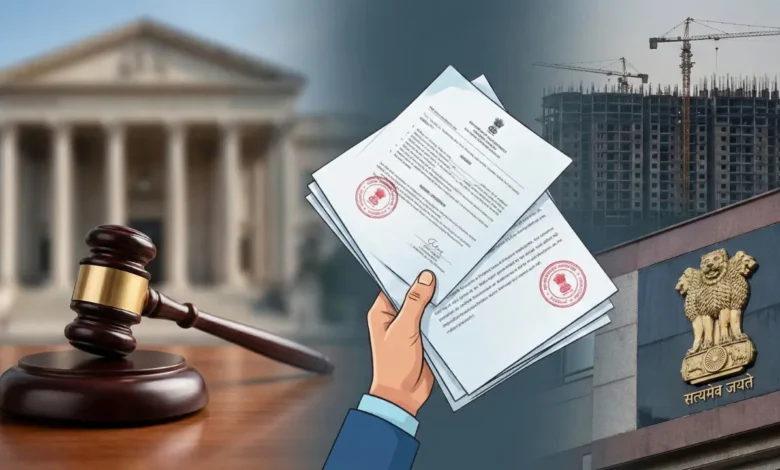
The Supreme Court has asked the Uttar Pradesh government to produce past approvals granted to Amrapali projects, aiming to remove hurdles in issuing completion and occupancy certificates for thousands of homebuyers.
-
UP government asked to trace and submit Amrapali-era statutory clearances
-
Joint meeting ordered to resolve CC and OC bottlenecks
-
Relief likely for nearly 45,000 affected homebuyers in NCR
The Supreme Court of India has directed the Uttar Pradesh government to produce copies of all statutory clearances and certificates earlier issued to the erstwhile Amrapali Group, a move aimed at breaking the long-standing deadlock over completion and occupancy certificates for thousands of homebuyers in Noida and Greater Noida.
The absence of these documents has emerged as a major obstacle in granting Completion Certificates (CC) and Occupancy Certificates (OC) for residential projects that were completed by NBCC (India) Ltd under the court’s supervision. Many of these documents, including environmental approvals and safety clearances, were originally issued to Amrapali before construction began and are no longer available with current stakeholders.
In an order passed on December 11, a bench comprising Justices Sanjay Kumar and Satish Chandra Sharma directed that a joint meeting be convened between officials of the Noida and Greater Noida authorities, the court-appointed receiver R Venkataramani, and NBCC to resolve procedural hurdles blocking the issuance of CCs and OCs.
The court emphasised that authorities must avoid prolonging the matter on technical grounds. “Effort shall be made by all concerned to settle the issue instead of prolonging it further on technicalities,” the bench observed.
Authorities Asked to Verify Past Clearances
The direction followed a detailed note submitted by Venkataramani, who highlighted that development authorities were insisting on multiple documents that were originally in Amrapali’s possession. These include environmental clearances, fire safety approvals, lift and electrical safety certificates, labour cess records, and “no dues” certificates.
The court instructed the state government to independently verify whether such clearances were obtained by the original developer before project commencement. If confirmed, certified copies of these approvals must be produced before the court at the next hearing.
Importantly, the bench clarified that the Noida and Greater Noida authorities should not insist on documents that were in Amrapali’s custody. Instead, any verification required for statutory compliance should be carried out directly with the relevant state departments.
Impact on Homebuyers and Utilities
The lack of CCs and OCs has also delayed essential services. According to the receiver’s note, water connection fees and one-year advance charges were deposited as early as May 24, 2024. However, connections could not be released due to the absence of occupancy approvals.
While the development authorities informed the court that water connections were being provided irrespective of outstanding dues, they maintained that building bye-laws do not allow exemptions for issuing CCs and OCs without statutory compliance.
Senior advocate Ravindra Kumar, representing the authorities, cautioned that granting OCs without complete documentation could expose officials to liability in case of accidents such as fire, lift failure, or electrical mishaps.
Background: Amrapali Crisis
The order has brought renewed hope for buyers across five projects in Greater Noida and seven in Noida, which were completed by NBCC following the Supreme Court’s landmark 2019 judgment. That ruling cancelled Amrapali’s RERA registration after its promoters were accused of siphoning off homebuyers’ funds and handed over project completion to NBCC.
Nearly 45,000 homebuyers, who booked homes between 2005 and 2013 with promised delivery timelines of three years, were left stranded due to prolonged delays, loan defaults, and insolvency proceedings. Their collective petition led to sustained judicial intervention.
Next Steps and Ongoing Investigations
The court posted the matter for further hearing on January 22 and accepted a proposal for a joint meeting on December 22. People familiar with the developments said the meeting was held as scheduled, with state departments agreeing to form sub-committees to trace Amrapali-era documents. If records remain untraceable, the court may be approached for further directions.
Separately, the Supreme Court also directed the Enforcement Directorate to submit a status report on investigations linked to cheating complaints filed by homebuyers. At least 59 FIRs have been registered, most of which are currently at the trial stage.
Homebuyers’ representatives informed the court that recoveries of around ₹2,600 crore are still pending through attachment of properties belonging to Amrapali’s former promoters, as mandated under the 2019 ruling.