
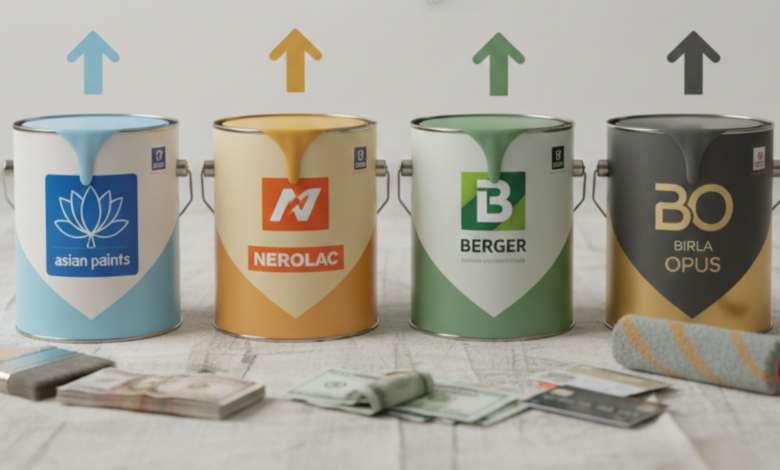
How Paint Brands Affect Your Home Painting Cost: Asian, Nerolac, Berger, Birla Opus
Choosing the right paint brand can dramatically impact your painting budget, finish quality, and long-term durability. Here’s a detailed comparison of Asian Paints, Nerolac, Berger, and Birla Opus.
-
Paint brand selection influences coverage, durability, and total cost significantly
-
Premium brands like Asian Paints offer better long-term value despite higher upfront costs
-
Budget-friendly options like Birla Opus suit small projects and tight renovation budgets
When homeowners plan to paint their homes, the paint brand they choose can make a bigger difference than the square footage of the property. Two homes of identical size can incur vastly different costs purely due to the brand selected.
Understanding how paint brands affect both painting cost and long-term value is essential for budget planning, quality finishes, and maintenance considerations. H4ENEWS insights based on real project experiences provide a clear picture of what each major Indian paint brand offers.
Why Paint Brand Choice Impacts Painting Costs
Painting costs are not just about price per litre. Several factors tied to the brand influence the final expense:
-
Coverage efficiency: How many square feet a litre of paint can cover
-
Number of coats required: Some paints need more layers for uniform finish
-
Durability & washability: Higher-quality paints last longer, reducing repaint cycles
-
Wall compatibility: Some brands perform better on certain surfaces
Tip: Always calculate brand-specific costs using a reliable painting cost calculator to avoid surprises.
Brand-by-Brand Analysis
Asian Paints – Premium Finish, Higher Cost
-
Price Range: High
-
Why it Costs More: Offers excellent coverage, premium emulsions like Royale and Apcolite, superior smoothness, and color depth
-
Cost Impact: Higher per-litre price but fewer repaint cycles
-
Best For: Luxury homes and homeowners prioritizing finish and durability
-
H4ENEWS Insight: Asian Paints performs best on properly prepped walls. Using putty and primer reduces consumption and justifies the premium price.
Kansai Nerolac – Value for Money
-
Price Range: Medium
-
Why it’s Cost-Efficient: Balanced coverage, good durability, eco-friendly options
-
Cost Impact: Slightly higher paint quantity needed than Asian Paints, but overall cost remains budget-friendly
-
Best For: Rental properties, budget-conscious homeowners
-
H4ENEWS Insight: Nerolac delivers excellent results when paired with proper surface preparation, making it a reliable mid-range option.
Berger Paints – Mid-Premium Choice
-
Price Range: Medium to High
-
Why Homeowners Choose Berger: Smooth application, competitive pricing in premium segment, durable interior and exterior ranges
-
Cost Impact: Labour effort similar to Asian Paints; slightly lower material cost
-
Best For: Homeowners seeking premium finishes without top-tier pricing
-
H4ENEWS Insight: Skilled application is key. Proper labour ensures Berger paints achieve their full potential.
Birla Opus – Emerging & Cost-Effective
-
Price Range: Low to Medium
-
Why it’s Gaining Popularity: Affordable pricing, decent coverage, strong brand reputation
-
Cost Impact: May require an extra coat, but initial material cost is low
-
Best For: First-time homeowners, tight renovation budgets
-
H4ENEWS Insight: Ideal for budget projects when expectations are aligned and labour is planned carefully.
Brand Comparison at a Glance
| Brand | Paint Cost | Coverage | Finish Quality | Long-Term Value |
|---|---|---|---|---|
| Asian Paints | High | Excellent | Premium | Very High |
| Nerolac | Medium | Good | Good | High |
| Berger | Medium–High | Very Good | Premium | High |
| Birla Opus | Low–Medium | Average–Good | Decent | Medium |
How Paint Brand Affects Labour Cost
The choice of paint brand also influences labour charges:
-
Premium paints often require skilled painters
-
Some brands need longer drying times between coats
-
Smooth finishes demand extra wall prep and precision
This is why H4ENEWS recommends factoring brand-specific labour costs rather than relying on flat-rate assumptions, especially for large-scale projects.