
Indian Real Estate in 2025: How the Market Found Stability After Years of Volatility
Indian real estate in 2025 moved past speculation and uncertainty, emerging as a mature, infrastructure-led sector driven by end-users, disciplined developers, and steady demand across residential, commercial, and alternative assets.
-
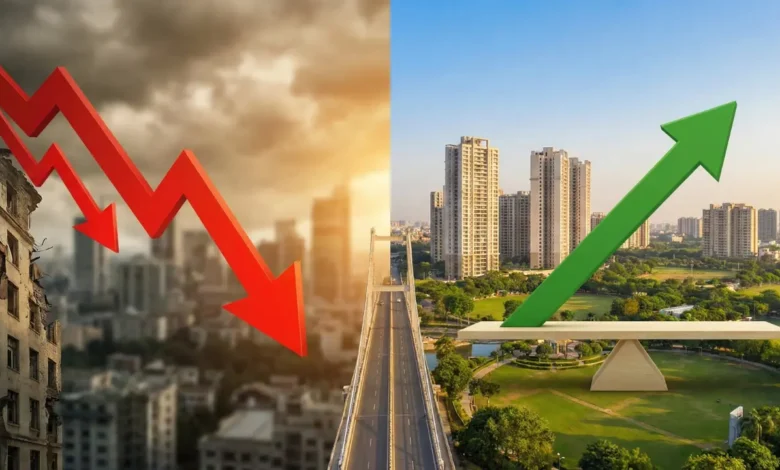
Home prices rise despite slower sales volumes, signalling market maturity
-
Infrastructure delivery reshapes NCR and key urban corridors
-
Luxury, office, retail, and warehousing segments show balanced growth
New Delhi: As 2025 draws to a close, Indian real estate finds itself on unusually solid ground. After decades marked by sharp cycles of booms and corrections, the sector has entered a phase defined less by excitement and more by stability. Despite global economic uncertainty, geopolitical tensions, and shifting monetary policies, the property market in India displayed resilience and restraint—traits that were rarely associated with it in the past.
Rather than a runaway rally or a demand collapse, 2025 delivered a steady transition toward a more institutionalised, end-user-driven ecosystem. Developers focused on execution, buyers became discerning, and investors grew selective. Most importantly, infrastructure moved from vision documents to visible, on-ground progress.
Residential Market Shows Strength Beneath Softer Volumes
Housing continued to anchor the real estate market, even though sales moderated compared to the previous year. Industry estimates suggest that residential sales across the top cities stood at around 395,000 units in 2025, roughly 14 per cent lower than 2024 levels.
Yet, prices told a different story. Across most key markets, average home values moved upward, underlining a crucial shift in buyer behaviour. Purchasers were no longer chasing quick gains or bargain deals. Instead, they prioritised trusted developers, well-connected locations, spacious homes, and projects offering long-term livability.
Industry leaders say this divergence between volumes and prices reflects growing confidence. Buyers are willing to pay a premium for quality, better layouts, and community-focused developments—signals of a healthier, more sustainable market.
NCR Benefits from Infrastructure Becoming Reality
The National Capital Region emerged as one of the strongest residential performers of 2025. Infrastructure projects that once existed largely in announcements—such as the Dwarka Expressway, metro extensions, and connectivity around the upcoming Noida International Airport—began reshaping buyer sentiment.
Noida, Greater Noida, and Ghaziabad, in particular, saw rising traction as infrastructure upgrades translated into real accessibility and livability. These corridors are now viewed as strategic long-term bets rather than speculative plays, attracting both end-users and long-horizon investors.
Luxury housing in NCR has also evolved. What was once aspirational has become actionable, with buyers actively upgrading to larger, better-designed homes supported by improved connectivity and social infrastructure.
Luxury Housing Expands Beyond Metros
One of the most notable shifts in 2025 was the spread of luxury housing demand beyond traditional metro markets. While cities like Delhi-NCR, Mumbai, and Bengaluru remained dominant, select Tier-II cities recorded surprising absorption levels in premium segments.
Improved highways, rising disposable incomes, and evolving lifestyle aspirations have encouraged buyers in these cities to seek metro-grade design, amenities, and community experiences. Importantly, this demand was largely driven by end-users rather than speculative investors.
Within NCR, Noida–Greater Noida made a decisive entry into the luxury housing league, supported by expressways, metro connectivity, and visible airport progress. Demand came from professionals, entrepreneurs, and NRIs looking for long-term value rather than short-term appreciation.
Prices Rise as the Market Matures
The steady increase in prices despite moderated transaction volumes highlighted the sector’s coming-of-age moment. Buyers showed a willingness to pay more for reliability, execution capability, and superior planning.
Developers, in turn, adopted a more disciplined approach—launching projects cautiously, managing inventory better, and focusing on delivery timelines. Consolidation also gained pace, with branded developers strengthening their market share as buyers gravitated toward transparency and trust.
Commercial Offices Rebound Strongly
India’s office market delivered one of its strongest performances in years, with leasing activity crossing 80 million square feet. Global Capability Centres (GCCs) accounted for nearly 40 per cent of total absorption, reinforcing India’s role as a global business and technology hub.
Bengaluru, Delhi-NCR, Hyderabad, and Pune led demand, supported by talent availability, competitive costs, and upgraded infrastructure. Hybrid work models stabilised, allowing companies to commit to long-term office spaces with greater clarity.
Retail, Warehousing, and New Segments Gain Ground
Retail real estate benefited from rising consumption and a preference for experience-led destinations. Prime malls, high-street assets, and mixed-use developments performed well, driven by food, entertainment, and luxury brands.
Warehousing and logistics continued their steady climb, backed by e-commerce growth, manufacturing expansion, and supply-chain realignment. Grade-A facilities, automation, and ESG compliance became standard expectations for institutional investors.
Beyond traditional segments, senior living, healthcare real estate, data centres, and integrated townships gained momentum, reflecting demographic shifts and India’s growing digital economy.
Tier-II Cities Step Into the Spotlight
Tier-II and Tier-III cities such as Mohali, Tricity, Faridabad, and Lucknow recorded consistent end-user demand. Buyers in these markets showed a preference for low-density, wellness-oriented projects with modern amenities—further evidence of changing residential priorities across India.
Outlook for 2026: Cautious Optimism
Looking ahead, industry sentiment remains positive but measured. Many developers expect price appreciation of over 5 per cent in 2026, supported by steady GDP growth, stable interest rates, and continued infrastructure spending.
Emerging trends such as AI-enabled buildings, wellness-first design, transit-oriented developments, and branded residences are expected to shape the next growth phase.
Conclusion
Indian real estate in 2025 was not about dramatic highs or sharp corrections. It was about consistency, delivery, and discipline. The sector finally displayed the characteristics of a mature market—anchored by infrastructure, driven by genuine demand, and focused on long-term value.
As 2026 begins, the foundation appears firm, suggesting that future growth will be thoughtful and sustainable rather than speculative.