

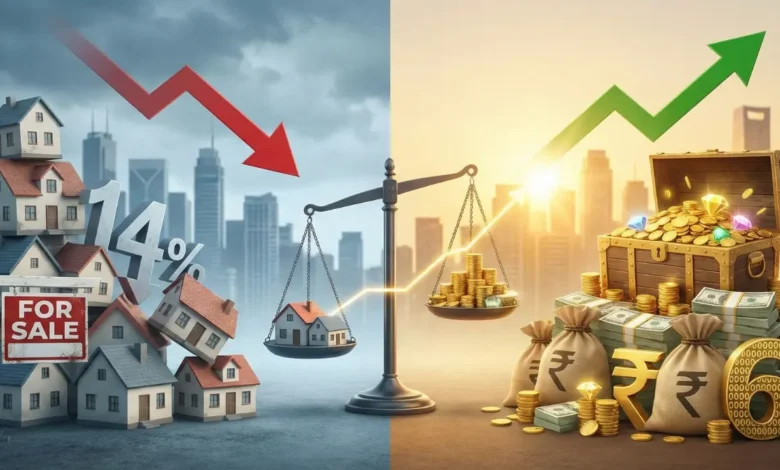
Housing Sales Drop 14% in Top Cities, Value Crosses ₹6 Lakh Crore
Despite a sharp drop in housing sales volumes across India’s major cities in 2025, rising property prices and growing demand for larger, luxury homes pushed overall transaction values higher.
-
Housing sales declined 14% to 3.96 lakh units in 2025
-
Total housing transaction value rose 6% to over ₹6 lakh crore
-
Ultra-luxury homes priced above ₹40 crore saw a 66% jump in sales
Housing sales across India’s top seven cities fell sharply by 14% year-on-year to around 3.96 lakh units in 2025, according to a joint report by the Indian Chamber of Commerce (ICC) and Anarock. However, even as volumes declined, the total value of residential transactions climbed 6% to exceed ₹6 lakh crore, highlighting a major shift in buyer preferences.
Industry experts say the contrasting trend between sales volume and value reflects a growing inclination towards premium and spacious homes. Buyers are increasingly opting for larger configurations and upscale properties, pushing overall deal values higher despite fewer units being sold.
The report shows a clear move away from budget housing. Homes priced below ₹75 lakh, which made up nearly 60% of housing sales in 2021, now account for just about 32% of transactions. On the other hand, properties priced above ₹4 crore contribute nearly 18–20% of total sales across the top cities, compared to only 1–2% before the pandemic.
Anuj Puri, Chairman of Anarock Group, noted that the ultra-luxury segment has emerged as a key growth driver. Homes priced at ₹40 crore and above recorded a steep 66% rise in sales during 2025, with the Mumbai Metropolitan Region accounting for more than 70% of these high-value deals.
Also Read: UltraTech Cement: How Strategy and Scale Created India’s Market Leader
Buyer preferences have also evolved in terms of home size and layout. The share of 3BHK and larger apartments has grown to nearly 45–50%, up from around 30% in 2018. Average home sizes across major cities have expanded by roughly 40% since 2021. The National Capital Region (NCR) stood out, with average unit sizes almost doubling between 2022 and 2025.
While demand patterns are changing, price trends have also stabilised. After muted growth between 2015 and 2019, residential prices surged by nearly 54% during 2019–24, supported by post-pandemic recovery, infrastructure development, and consolidation among large developers. In 2025, price appreciation moderated to about 8%, indicating a more balanced market.
On the supply side, India’s residential sector is becoming increasingly institutionalised. Listed and grade-A developers now account for around 45% of total housing supply, compared to 28% five years ago. Over the past five years, nearly 12,700 acres of land have been transacted nationwide, with close to 60% allocated for residential projects.
Also Read: Khansaheb Group Acquires ANABEEB from EMSTEEL
The report also highlights strong macroeconomic support for long-term housing growth. Private consumption contributes nearly 60% to India’s GDP, government capital expenditure has tripled since FY19, and banks are operating with net NPAs at multi-decade lows. Additionally, India’s mortgage-to-GDP ratio remains at about 11%, far below global averages, indicating significant potential for future housing finance expansion.
Together, these trends suggest that while housing sales volumes may have softened in 2025, India’s residential market is undergoing a structural transformation—one increasingly defined by premium living, larger homes, and long-term confidence in urban real estate.
About H4ENEWS
At H4ENEWS, we are more than just a news portal – we are your ultimate destination for everything related to home decor, real estate, architecture, Kitchen, Bathroom, Vastu, Celebrity, construction and more. Our mission is simple: to keep homeowners, buyers, sellers, real estate enthusiasts, and industry professionals informed with accurate, reliable, and timely news.