
GST Cuts to Reduce Construction Costs by 7%: Amit Shah
Union Home Minister Amit Shah says GST rate cuts on housing and building materials have significantly benefited real estate, lowering construction costs and supporting affordable, sustainable urban development across India.
-
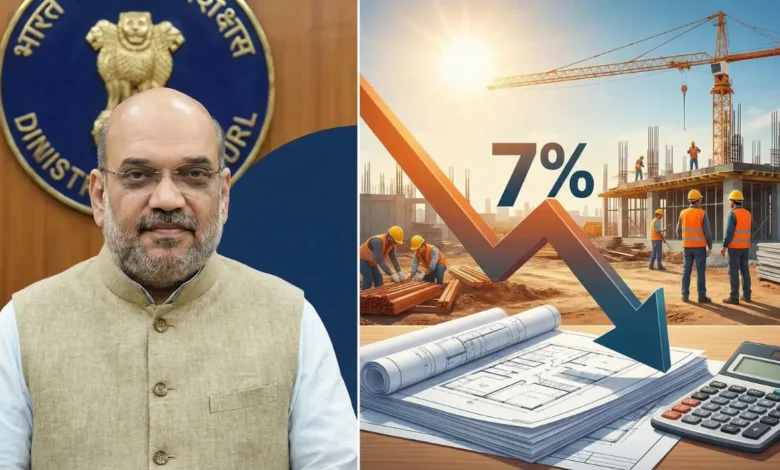
GST cuts could reduce construction costs by 5–7%
-
Affordable housing GST lowered to 1%, cement to 18%
-
Urban population expected to reach 50% by 2047
The Indian real estate sector has emerged as one of the biggest beneficiaries of recent Goods and Services Tax (GST) reforms, with construction costs likely to decline by up to 7%, Union Home Minister and Minister of Cooperation Amit Shah said on Friday. Addressing CREDAI’s national conference, “Viksit Bharat @ 2047”, Shah highlighted how targeted tax reductions and policy reforms are reshaping housing affordability and urban development in the country.
According to Shah, the government’s decision to rationalise GST rates across housing and construction materials has directly eased cost pressures on developers, ultimately benefiting homebuyers. He noted that GST on affordable housing has been reduced from 8% to 1%, while GST on housing projects has come down from 12% to 5%. Key construction inputs such as cement have seen GST reduced from 28% to 18%, while marble, granite, sand, lime, bricks, and bamboo flooring are now taxed at 5% instead of 12%.
“These reforms together create the possibility of reducing building construction costs by around 5–7%,” Shah said, adding that lower costs could help stabilise housing prices and expand access to home ownership.
The Home Minister also underlined the government’s commitment to strengthening the real estate ecosystem through investment-friendly policies. He pointed out that 100% foreign direct investment (FDI) has been permitted in construction projects under the automatic route, while a ₹60,000 crore National Urban Housing Fund has been released to support housing development and urban infrastructure.
Linking real estate growth to India’s long-term economic vision, Shah said Prime Minister Narendra Modi has set the goal of transforming India into a leading global economy by 2047, aligned with the $5 trillion economy benchmark. Over the past 11 years, he said, the government has laid strong foundations for next-generation infrastructure, including the rollout of the National Infrastructure Pipeline, which aims to bring structured and future-ready urban development across the country.
Shah emphasised that urbanisation in India is expected to accelerate rapidly. He projected that around 40% of India’s population will live in urban areas by 2035, rising to nearly 50% by 2047. With this shift, the responsibility of meeting housing demand will increasingly rest on real estate developers. He urged CREDAI to proactively plan for affordable, eco-friendly housing that offers better living standards while supporting sustainable city growth.
Highlighting governance reforms, Shah said measures such as single-window clearances, time-bound approvals, online tracking systems, and digitised land and project records have significantly improved transparency and trust in the real estate sector. He added that these reforms would be further accelerated to ensure faster project execution and investor confidence.
The Home Minister described the Real Estate (Regulation and Development) Act (RERA) as a “structural breakthrough” for the sector. He noted that RERA has been implemented across 35 states and Union territories, with appellate authorities constituted in 29 states. As of now, around 1.55 lakh real estate projects and nearly 1.10 lakh developers are registered under RERA, providing stronger protection for homebuyers and improving accountability within the industry.
Shah also acknowledged CREDAI’s role in shaping India’s real estate sector since 1999. As the apex body representing private developers, CREDAI operates in 230 cities across 21 states and represents nearly 13,000 developers. He said the organisation has trained over three lakh workers and played a key role in establishing ethical practices and professional standards within the industry.
On sustainability, Shah praised CREDAI’s environmental initiatives, including the plantation of 20 lakh saplings and the rejuvenation of 9,000 acres of barren land across 25 villages. He encouraged developers to integrate green spaces into project designs and suggested that planting at least 10 trees per building could create a significant positive environmental impact.
Concluding his address, Shah said the government recognises the real estate sector as a critical driver of economic growth and employment. He urged developers to adopt green building norms, energy-efficient designs, water recycling, rainwater harvesting, and scientific waste management as standard practices. Through collective responsibility and sustainable planning, he said, the goal of “Housing for All” can be realistically achieved.