
Ghaziabad Residents Oppose Registrar Office Shift to Noida
Housing societies and resident groups in Ghaziabad oppose the state government’s decision to relocate the deputy registrar office to GB Nagar, citing inconvenience, poor infrastructure, and lack of digitisation.
-
Nearly 10,000 societies in Ghaziabad may be directly affected
-
Residents demand separate deputy registrar office for both districts
-
Concerns raised over lack of digitisation and staffing shortages
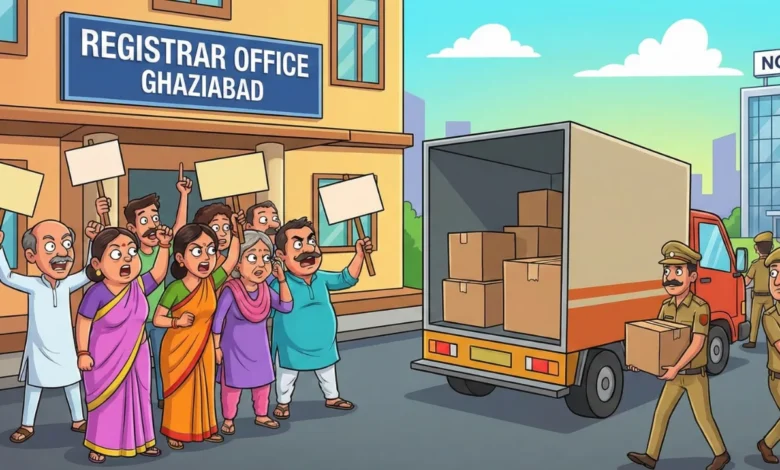
Ghaziabad: Resident welfare associations and civil society groups in Ghaziabad have raised strong objections to the state government’s decision to shift the office of the deputy registrar (firms, societies and chits) to Gautam Budh Nagar (GB Nagar), saying the move will create administrative challenges for thousands of registered bodies.
Currently, the Ghaziabad office manages records and compliance work for both Ghaziabad and GB Nagar districts. However, residents argue that relocating the office to Noida would force office-bearers of housing societies, RWAs, AOAs, NGOs, and welfare organisations to travel to another district for routine tasks such as registrations, renewals, and documentation.
According to official figures, around 15,500 societies are registered across the two districts. Of these, nearly 10,000 are based in Ghaziabad, while approximately 5,500 operate in GB Nagar. Resident groups say this imbalance makes the proposed relocation impractical.
The Social Awareness Society, a local residents’ group, has formally written to the Prime Minister, the Chief Minister, the Chief Secretary, the Registrar (firms, societies and chits), and the District Magistrate, requesting authorities to reconsider the decision. The group has suggested appointing separate deputy registrars for both districts instead of shifting the existing office.
Vineet Sharma, a representative of the society, said the move would disrupt routine administrative work. He pointed out that the Ghaziabad office currently functions with a staff strength of about 13 and continues to manage records that are largely not digitised. “Instead of strengthening the current setup with additional staff and improved digital systems, relocating the office reflects a disconnect from ground realities,” he said.
Residents also expressed concern that there is no clarity on whether weekly sittings will continue in Ghaziabad after the shift. Dipanshu Mittal, executive member of the Raj Nagar Extension federation, said Ghaziabad has nearly double the number of registered housing societies compared to Noida. “Relocating the office despite this data will inconvenience thousands of residents who depend on these services regularly,” he added.
Meanwhile, officials from the registrar department indicated that while Ghaziabad currently has a larger number of societies due to its population size, GB Nagar is expected to witness rapid growth, particularly in high-rise residential developments. Authorities suggest that future expansion patterns may have influenced the decision.
For residents and society office-bearers, the key demand remains improved accessibility and efficient service delivery. Many believe that digitisation, increased staffing, and decentralised administrative support could be more practical solutions than relocating the office entirely.
Also Read: NBCC in Talks for 139-Acre Seychelles Housing Project
Also Read: Asian Paints Unveils Moonlit Silk as Colour of 2026