
Delhi Startup Reinvents Construction with Cement-Free Technology, Wins TATA and Adani Projects
Delhi-based Vishwa Hara Chakra is changing India’s construction landscape by replacing cement with carbon-negative materials, securing projects from TATA, Adani and government agencies while tackling the country’s massive waste problem.
-
Startup converts construction and industrial waste into cement-free building materials
-
Secures major contracts from TATA, Adani Group, NBCC and Indian Army projects
-
Aims to make India’s construction sector carbon-negative
In an industry known for high carbon emissions and massive waste, a young Delhi-based startup is quietly rewriting the rules. Vishwa Hara Chakra, founded in 2024, has developed a way to build without cement, turning industrial and construction waste into strong, carbon-negative building materials — a breakthrough that has already attracted clients such as TATA Group, Adani Group, NBCC, ITDC and the Indian Army.
India produces between 150 and 500 million tonnes of construction and demolition waste every year. Add to that nearly 400 million tonnes of cement and around 200 billion bricks annually, and the environmental cost becomes staggering — polluted air, contaminated water, landfills under pressure and huge carbon emissions. Cement production alone accounts for more than 8–10% of global CO₂ emissions.
Vishwa Hara Chakra was created to tackle this challenge head-on.
“We realised that while construction is necessary for India’s growth, it is also one of the biggest contributors to environmental damage,” said co-founder Megha Rathee. “So instead of trying to reduce cement use, we decided to eliminate cement altogether.”
From Education to Climate Technology
Rathee’s journey into green construction did not start in engineering labs but in classrooms. Coming from Rajpur Khurd village in Delhi, she spent two decades in education, working as a teacher and later as a school principal. Her focus on systems, discipline and long-term impact eventually led her to look beyond education and into sustainability.
A chance meeting with Professor Ashwin Gopinath, a Massachusetts-based academic specialising in sustainability and materials science, proved pivotal. Their shared interest in circular economy models and waste management soon turned into months of research on India’s construction waste problem.
By 2024, along with climate-tech entrepreneur Abhishek Chhazed and retired Army commander Lt. Gen. J.S. Nain as advisory founder, the team officially launched Vishwa Hara Chakra with an initial investment of ₹25 lakh.
Cement-Free, Carbon-Negative Materials
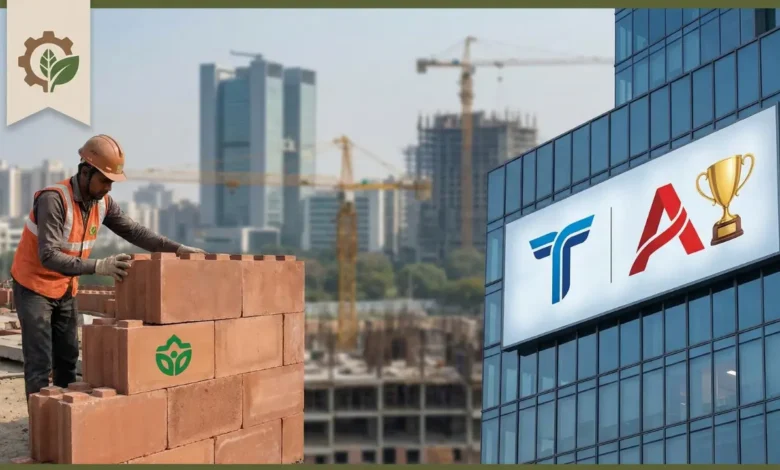
At the core of the startup’s innovation is its Eco-Concrete technology, which replaces cement with industrial by-products such as fly ash and slag, along with specialised chemical binders.
Traditional cement emits about 80 grams of CO₂ per kilogram. Vishwa Hara Chakra’s solution removes cement completely, drastically reducing emissions while maintaining strength and durability.
The Eco-Concrete mix contains:
-
Recycled industrial waste
-
Chemical binding agents
-
Coarse and fine aggregates
-
Water for activation
The result is a strong, durable building block with up to 80% lower carbon emissions and less than 1% production waste. Even more remarkably, it requires no high-temperature heating, further cutting energy consumption.
Beyond Bricks: Insulation and Waste-to-Energy
The startup has also developed Zephyr Insulation, a high-performance thermal protection system designed for water tanks, pipelines and buildings in extreme climates, including the Himalayas.
Zephyr prevents freezing at temperatures as low as –30°C, reduces heat loss by up to 80%, and cuts energy use in pipelines by nearly 70%. The technology is already being used by the Indian Army in high-altitude bases, helping them avoid water freezing and reducing reliance on risky fuel convoys.
In parallel, the company runs a waste-to-energy initiative, producing Compressed Bio-CNG from agricultural and municipal waste, adding another layer to its circular economy model.
From Rejection to Major Contracts
Convincing the conservative construction industry was not easy. Early pitches were often dismissed as risky or untested. That changed when Vishwa Hara Chakra secured its first big order — a ₹1.8 crore project from TATA for the Noida International Airport near Jewar.
Since then, its client list has grown to include Adani Group, ITDC, MES, Border Roads Organisation, NBCC, and defence installations in Kargil and Rohtang Pass.
The company has already crossed ₹5 crore in revenue within a year of operations.
The Road Ahead
Vishwa Hara Chakra now plans to scale its insulation technology and expand into climate-challenged regions such as Bikaner and Jaisalmer. Its larger goal is ambitious: to make India’s construction industry carbon-negative.
“We are proving that sustainability does not mean compromising on performance,” said Rathee. “If we can build airports, army bases and highways without cement, then the future of construction can truly be green.”
As India pushes ahead with massive infrastructure and housing plans, startups like Vishwa Hara Chakra could play a crucial role in ensuring that growth does not come at the cost of the planet.