
Delhi allows regularisation of 1,521 illegal colonies
Delhi’s revamped PM-UDAY-linked system enables faster property regularisation through a fully digital process, helping lakhs of homeowners secure legal ownership, access loans, and eliminate long-standing property disputes.
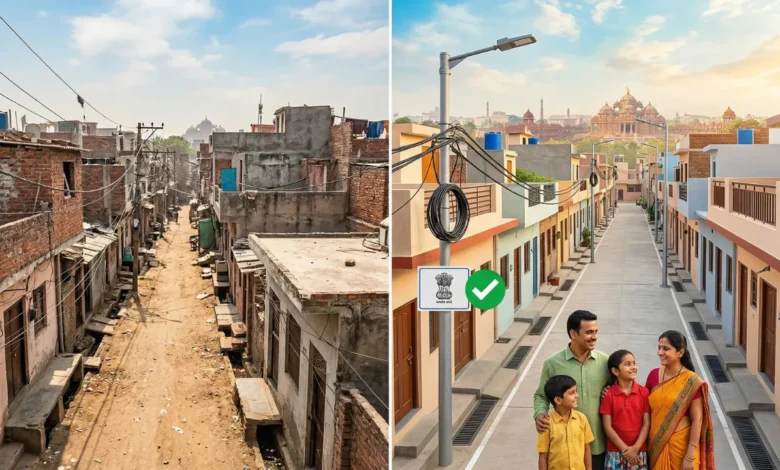
- Over 10 lakh homes to gain legal ownership under PM-UDAY
- Fully online process via integrated government portals
- AI-based drone monitoring to prevent illegal construction
New Delhi: In a major step towards resolving long-pending property issues, the Delhi government has streamlined the property regularisation process under the PM-UDAY (Pradhan Mantri Unauthorised Colonies in Delhi Awas Adhikar Yojana) scheme. The updated system, integrated with the MCD Swagam portal, aims to provide legal ownership to over 10 lakh residents living in unauthorised colonies across the capital.
The move is expected to significantly reduce paperwork, delays, and confusion that earlier plagued the regularisation process. By digitising applications and linking multiple government platforms, authorities are now offering a faster and more transparent way for residents to secure property rights.
Officials have clarified that even residents who have not yet registered under PM-UDAY can still apply. Applicants need to first register on the PM-UDAY portal and apply for a property card. Once completed, they can return to the MCD Swagam portal to continue the process.
After registration, property owners can apply for key documents such as an authorisation slip and a conveyance deed, both of which are essential for establishing legal ownership. This flexibility ensures that new applicants are not left out of the regularisation drive.
The policy is set to transform property ownership across Delhi by granting legal recognition to homes that were previously considered unauthorised. Once regularised, property owners can freely sell, buy, or even use their property as collateral for loans.
The scheme covers more than 1,500 unauthorised colonies across 13 districts, bringing relief to lakhs of families who have lived for years without clear ownership rights. For many residents, this marks the end of legal uncertainty and opens up new financial opportunities.
The updated framework is based on a practical “as-is, where-is” approach, meaning properties will be regularised in their current condition without requiring approved layout plans. This removes one of the biggest hurdles faced by applicants in the past.
Additionally, the entire process—from application to approval—has been made fully online. This digital transformation is expected to reduce human intervention, minimise errors, and ensure quicker approvals.
Despite its wide coverage, not all colonies are included in the scheme. Around 220 unauthorised colonies have been excluded due to specific restrictions. These include areas located in environmentally sensitive zones such as forests, the Delhi Ridge, and Yamuna floodplains.
Colonies situated near protected monuments or those classified as high-income or affluent areas are also not eligible under the policy. Authorities say these exclusions are necessary to maintain environmental balance and protect heritage zones.
To ensure that the regularisation process is not misused, the Municipal Corporation of Delhi (MCD) has introduced strict monitoring measures. Authorities will conduct bi-monthly AI-based drone surveys across all regularised colonies.
These surveys aim to detect and prevent any new illegal construction after properties receive legal status. The use of technology is expected to improve compliance and maintain planned urban development.
In the past, property regularisation in Delhi faced multiple challenges, including missing layout plans, complex documentation, and delays in approvals. Many residents struggled to obtain ownership documents despite living in their homes for decades.
With over 40,000 conveyance deeds already issued, the revamped system is expected to accelerate the process for the remaining applicants. The integration of digital platforms and simplified procedures marks a significant shift in how urban housing issues are addressed in the city.
Experts believe this could be one of the largest regularisation drives in Delhi’s history. By bringing lakhs of properties into the legal framework, the government is not only improving urban governance but also boosting the real estate ecosystem.
For residents, however, the impact is far more personal. Beyond policy and paperwork, this initiative represents long-awaited legal recognition, financial security, and peace of mind.