
Should You Use EPF Money to Repay Your Home Loan?
Using EPF savings to repay a home loan may seem tempting, but the long-term impact on retirement security, tax-free compounding, and future cash flow deserves careful and informed evaluation.

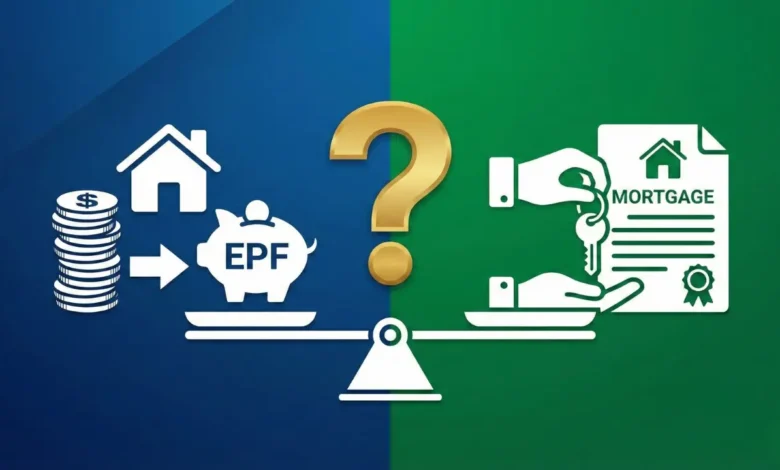
-
EPF offers tax-free, long-term compounding for retirement security
-
Home loans become cheaper over time as interest declines
-
Using EPF may solve today’s EMI stress but weaken future finances
For many salaried professionals, the idea surfaces unexpectedly. A quick glance at the EPF account reveals a healthy balance built steadily through monthly deductions and employer contributions. Then comes a look at the home loan statement—and the two numbers appear almost identical. The question follows naturally: should EPF money be used to repay the home loan and become debt-free?
At first glance, the math appears straightforward. Home loan interest rates today hover around 7–7.5 percent, while EPF currently earns about 8.25 percent annually. The gap seems narrow. Add to that the emotional appeal of closing a long-term loan and escaping EMIs, and the decision can feel logical.
However, this is where surface-level comparisons can be misleading.
Why EPF Is Not Just Another Investment
The Employees’ Provident Fund is not designed as a flexible savings account. It is a mandatory, long-term retirement instrument with one of its biggest advantages being completely tax-free returns. For someone in the highest tax slab, an 8.25 percent tax-free return is equivalent to earning close to 11 percent before tax from other investments.
Very few financial products in India offer this combination of safety, compounding, and tax efficiency over long periods.
A home loan, in contrast, is a declining liability. Each EMI reduces the principal, lowering the interest burden year after year. Salaries usually rise with experience, making EMIs easier to manage over time. Additionally, under the old tax regime, home loan interest and principal payments can offer tax deductions—though these benefits are not available under the new tax regime for self-occupied properties.
Understanding the Long-Term Trade-Off
To see the impact clearly, consider a simple scenario:
-
Outstanding home loan: ₹20 lakh
-
EPF balance: ₹20 lakh
-
EPF interest rate: 8.25 percent
-
Home loan interest rate: 7.5 percent
-
Time horizon: 10 years
Option 1: Use EPF to close the home loan now
You withdraw the entire EPF balance and repay the loan in full. The immediate benefit is psychological and financial relief—no EMIs and interest savings of roughly ₹9 lakh over 10 years.
But the hidden cost is significant. Your retirement corpus drops to zero. The power of compounding, which works best over long durations, is lost. Rebuilding this corpus later—when expenses are higher and time is limited—can be extremely difficult.
Option 2: Keep EPF intact and continue servicing the loan
If the EPF remains invested, ₹20 lakh growing at 8.25 percent can exceed ₹44 lakh in 10 years, entirely tax-free. Even after paying the home loan interest of around ₹9 lakh, you are left with a substantially larger financial cushion meant specifically for retirement years, when regular income stops and healthcare costs rise.
The difference between the two paths lies not in today’s EMI, but in future financial security.
The Hidden Risk of Using EPF
Using EPF money to repay a home loan may feel like a clean financial move, but it quietly transfers risk from the present to the future. While today’s cash flow improves, retirement preparedness weakens. EPF works best when left untouched for decades, allowing compounding to do its job.
When EPF Withdrawal May Make Sense
There are limited situations where using EPF for loan repayment could be justified:
-
You are very close to retirement
-
Your EPF corpus is already sufficient for post-retirement needs
-
Your home loan interest rate is significantly higher than EPF returns
-
Cash flow stress is severe and unavoidable
Outside these scenarios, most financial planners advise preserving EPF and managing home loan repayments through regular income.
The Bottom Line
With EPF continuing to offer higher, tax-free returns and home loan rates remaining moderate, the long-term math usually favours letting EPF compound while servicing the loan normally. Becoming debt-free early may feel comforting, but compromising retirement security can prove far more costly in the years ahead.