
Using House Sale Proceeds to Buy Two Flats and Transfer Them to Children Tax-Free
Selling a long-held house and reinvesting wisely can help you reduce capital gains tax, buy two adjoining flats, and ensure a smooth, tax-free transfer of property to your children.

-
Only long-term capital gains, not total sale value, must be reinvested
-
Two adjoining flats can qualify as one house under Section 54
-
Inherited property passed to children is not taxable
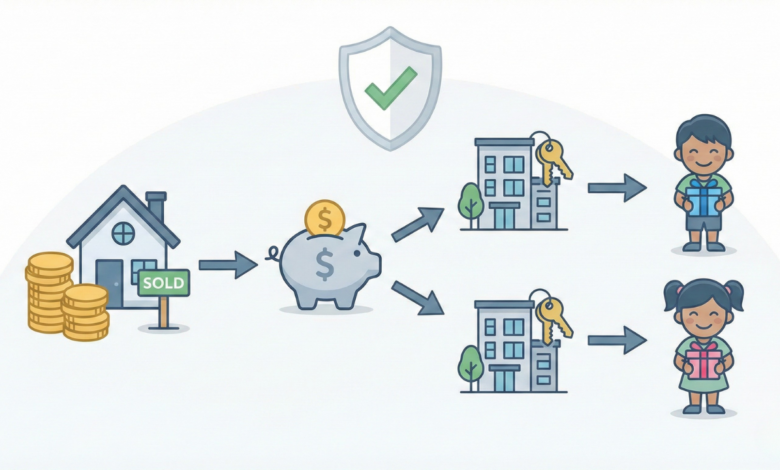
Many homeowners planning to sell a residential property often ask how they can reinvest the proceeds efficiently while also securing their children’s future. A common question is whether the sale proceeds of a house can be used to buy two flats—one for a son and one for a daughter—without triggering a tax burden. The answer lies in understanding how Section 54 of the Income Tax Act works and how ownership can be structured.
Only Capital Gains Matter, Not Full Sale Proceeds
A key point that often causes confusion is the amount that needs to be reinvested to claim tax exemption. Under Section 54, you are required to reinvest only the long-term capital gains (LTCG) arising from the sale of a residential house—not the entire sale consideration.
This means if your property was held for more than 24 months and qualifies as a long-term asset, the taxable portion is limited to the capital gain component. As a result, the reinvestment requirement is usually much lower than the total amount received from the sale.
Can You Buy Two Flats Instead of One?
The law generally allows exemption under Section 54 only when capital gains are invested in one residential house. However, tax authorities and courts have interpreted this rule with practical flexibility.
Several Income Tax Tribunal rulings have held that two or more adjoining flats used as a single residential unit can still be treated as “one house” for the purpose of Section 54. This typically applies when the flats are on the same floor or in the same building and are functionally combined to serve as one home.
So, if you plan to buy two adjoining flats and use them together as a single residence, the exemption under Section 54 may still be available—provided the facts support their use as one residential unit.
Buying the Property in Joint Names
Another important aspect is ownership structure. You are allowed to buy the new property in joint names with your son or daughter, even if they do not contribute financially.
For tax purposes, what matters is that:
-
The entire investment amount comes from you, and
-
The capital gains are properly reinvested within the specified timelines
Adding your children as joint owners does not automatically disqualify the Section 54 exemption, as long as you remain the primary investor.
Passing the Property to Children Tax-Free
If your long-term goal is to ensure that the property passes smoothly to your children, the most effective approach is estate planning. By clearly mentioning the property in your Will, you can bequeath it to your son and daughter.
Property received through inheritance is not taxable in the hands of the recipient. Your children will not have to pay any income tax simply for inheriting the house. Tax implications arise only if they later decide to sell the property, and even then, the cost and holding period are calculated based on your original ownership.
Special One-Time Option: Two Houses Under Section 54
Section 54 also offers a once-in-a-lifetime relief for taxpayers. If the long-term capital gains from selling a residential house do not exceed ₹2 crore, you may choose to invest the gains in two separate residential houses and still claim exemption.
This option can be particularly useful for parents who want to provide independent homes to their children. However, since this benefit can be claimed only once, it should be exercised carefully after evaluating long-term financial goals.
Final Takeaway
Using house sale proceeds smartly can help you achieve multiple objectives—saving tax, upgrading your living arrangement, and securing your children’s future. By reinvesting only the capital gains, purchasing adjoining flats as a single unit, adding children as joint owners, and backing it all with proper estate planning, you can structure the transaction in a tax-efficient and legally sound manner.
As tax rules can evolve and individual circumstances vary, consulting a qualified tax advisor before executing such transactions is always advisable.