Mumbai housing registrations reach all-time high in 2025
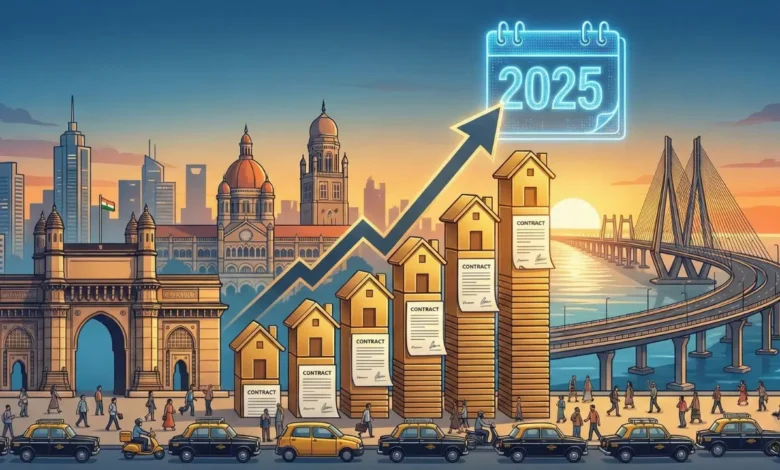
Mumbai recorded its highest-ever housing registrations in 2025, driven by year-end demand, even as affordability pressures, rising supply, and a mid-cycle slowdown begin reshaping buyer behaviour, a Nuvama report shows.

-
150,294 homes registered in 2025, up 6% year-on-year
-
Total transaction value rises 11% to ₹2.25 trillion
-
Affordable housing share continues to shrink
Mumbai: Mumbai’s residential property market reached a historic milestone in 2025, registering the highest number of home sales ever recorded, even as affordability challenges and signs of a mid-cycle slowdown became more visible.
According to a report by Nuvama Institutional Equities, the city recorded 150,294 registered housing units during the calendar year, marking a 6 per cent increase over 2024. The value of these registrations grew even faster, rising 11 per cent year-on-year to about ₹2.25 trillion, underlining the continued appetite for homeownership in India’s most expensive property market.
A significant portion of the momentum came from the year-end rush. December 2025 alone saw 14,424 registrations, a 16 per cent jump compared to December 2024. This made it the second-strongest December on record, surpassed only by December 2020, when buyers rushed to close deals ahead of stamp duty hikes after a temporary cut to 2 per cent.
Mid-Cycle Signals Begin to Emerge
Despite the headline-grabbing numbers, the Nuvama report cautions that the Mumbai Metropolitan Region (MMR) is now entering a mid-cycle phase. This stage is typically marked by a sharp rise in new supply and a gradual moderation in volume growth, even if headline registration figures remain strong.
The report notes that while demand is still resilient, future growth may face constraints unless affordability improves meaningfully. Housing volumes, by some measures, have already surpassed the peak seen during the previous upcycle, making further expansion more challenging under current pricing conditions.
Affordability Becomes a Key Concern
Affordability has emerged as the biggest structural challenge for Mumbai’s housing market. Data from Knight Frank, cited in the report, shows that the share of affordable homes priced below ₹1 crore declined to 42 per cent in December 2025, down from 44 per cent a year earlier.
At the same time, demand has steadily shifted toward higher price brackets. Homes priced between ₹1–2 crore now account for 32 per cent of registrations, while luxury properties above ₹5 crore have increased their share to 7 per cent. This trend highlights how rising prices and limited supply of mid-income housing are pushing buyers upward on the pricing ladder.
Where Buyers Are Purchasing
Geographically, demand continues to remain heavily skewed toward the Western suburbs, which accounted for 57 per cent of total registrations in December. The Central suburbs followed with a 29 per cent share, reinforcing their importance as relatively more affordable alternatives within city limits.
Buyer preferences by size have remained consistent. Homes measuring up to 1,000 square feet dominated the market, accounting for 82 per cent of transactions. Among these, 500–1,000 sq ft apartments were the most sought-after, making up 46 per cent of total registrations, reflecting a strong tilt toward compact, functional homes amid rising prices.
Outlook: Growth Likely to Be Moderate
Looking ahead, Nuvama expects only moderate price appreciation in the near term. The report highlights that sustaining high absorption levels will require either improved affordability or a meaningful increase in the supply of mid-income housing—both of which remain challenging under current conditions.
The brokerage also points to broader economic factors that could keep volatility elevated. These include weak job creation, global tariff tensions, and uneven economic growth patterns. As a result, the report suggests that real estate-linked stocks may remain range-bound, even as underlying housing demand stays resilient.
In summary, while 2025 has cemented Mumbai’s position as a high-activity housing market, the road ahead will depend less on volume records and more on how effectively affordability and supply mismatches are addressed.