
Gujarat High Court Halts Vadodara Construction, Says Society NOC Mandatory
The Gujarat High Court has ruled that construction within a cooperative housing society cannot proceed without its NOC, even if civic authorities have granted development permission.

-
High court stays 10-storey construction in Vadodara society
-
Civic nod alone not enough; society bylaws must be followed
-
Absence of society NOC invalidates development permission
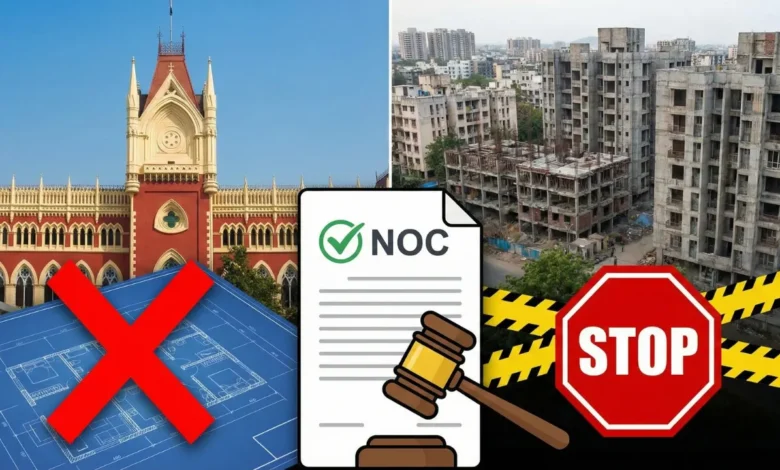
Ahmedabad: In a significant ruling impacting redevelopment within cooperative housing societies, the Gujarat High Court has stayed the construction of a multi-storey building in Vadodara, holding that a No Objection Certificate (NOC) from the housing society is mandatory, even when civic authorities have granted development permission.
The dispute involves the 60-year-old Alka Co-operative Housing Society Ltd in Vadodara. Owners of four plots began construction in 2024 after receiving development approval from the Vadodara Municipal Corporation (VMC). By the time the matter reached the high court, the structure had already risen to around 10 storeys.
The society objected to the construction, alleging that it encroached upon the society’s internal road and violated its bylaws, which restrict the plots to purely residential use. The society also maintained that construction was initiated without obtaining its consent, a requirement under its bylaws.
Initially, the society approached a Vadodara civil court seeking a stay, but no relief was granted. It then moved the Gujarat High Court challenging the legality of the ongoing construction.
Arguing for the society, advocate Sharvil Majmudar pointed out that while VMC had issued revised development permission in October 2022, the permission itself clearly stipulated that an NOC from the housing society was a precondition before commencing construction. Proceeding without such consent, he argued, rendered the construction illegal.
The plot owners defended their actions by relying on a 1980 society resolution, claiming it allowed them freedom to construct as they deemed fit. They also argued that the municipal corporation’s approval validated their project and barred the society from objecting at a later stage.
VMC, for its part, told the court that the dispute was essentially between the society and its members, and that its development permission complied with the General Development Control Regulations (GDCR). However, it also acknowledged that its approval explicitly required a society NOC before construction could begin.
After examining the records, Justice Niral Mehta noted the unfulfilled condition in the development permission and ruled that the construction could not be allowed to continue. The court observed that in the absence of a valid and subsisting development permission, the ongoing construction was legally unsustainable.
The high court further clarified that any construction within a cooperative housing society must strictly adhere to the society’s bylaws and must be preceded by the necessary consent of the society. The ruling reinforces the principle that civic approvals do not override internal governance rules of cooperative housing societies.